The State of Theology in 2025 is a biennial study from Lifeway Research, sponsored by Ligonier Ministries that surveys Americans’ beliefs about God, the Bible, theology, and more. This follows previous studies in 2014, 2016, 2018, 2020 and 2022. The Executive Director of Lifeway Research said the findings were both encouraging and challenging. Although many affirmed foundational doctrines of Christianity, their research also revealed “persistent misunderstandings and areas where biblical teaching is often overlooked.”
Beliefs About God
Consistent with past studies, the 2025 study found 71% of Americans agree there is one God in three Persons: God the Father, God the Son and God the Holy Spirit. “Americans with evangelical beliefs are more likely than those without evangelical beliefs to agree there is one true God in three Persons (97% v. 64%).” But they struggle with the logical implications of believing in one God in three Persons. Almost half of Americans deny the deity of Christ, saying Jesus was a great teacher, but not God (49%). While many Americans may not believe He is God, they do agree the biblical accounts of the bodily resurrection of Jesus are accurate (65%).
Although 97% of evangelicals affirm one true God in three Persons—God the Father, God the Son, and God the Holy Spirit—many who hold evangelical beliefs are still confused about what this means about God’s nature. More than half of evangelicals (53%) believe the Holy Spirit is a force but not a personal being, and 28% agree Jesus was a great teacher but He was not God. While most evangelicals affirm Trinitarian language, many misunderstand what it means.
This disconnect reveals churches need more than passionate preaching or engaging programs. They need clear, repeated, and practical theological instruction woven into the life of the church.
The State of Theology said the idea of the Trinity is found throughout the Bible, beginning in the first chapter of Genesis. Jesus and the apostles talked about it throughout the New Testament. The early church struggled to summarize what it believed about God until Tertullian, who lived about 100 years after Jesus’s resurrection, created the word “Trinity” to reference Scripture’s teaching about God.
In an aside from discussing the State of Theology findings, the theology of the Trinity was articulated within the first centuries of the church, most notably within various creeds like the Nicene Creed and Apostles Creed, and councils like the Council of Ephesus and the Council of Chalcedon. It reached its zenith with the Athanasian Creed. For more on the history of the creeds, see this link: Early Creeds.
Beliefs About Sin and Punishment
Americans tend to feel good about their own goodness and innocence. Two thirds (66%) believe everyone sins a little, but most people are good by nature. Three-fourths (74%) agree that everyone is borne innocent. Less than a quarter (23%) agree that even the smallest sin deserves eternal damnation. Seventy-one percent disagree, and 60% strongly disagree.
More than 3 in 5 Americans (62%) believe there will be a time when Jesus Christ returns to judge all people. Almost 3 in 5 (57%) say hell is a real place where some people will face eternal punishment. There are differences among Christians on their beliefs on sin and punishment. See the State of Theology for a graphic that illustrates this.
Beliefs About the Bible and Its Authority
American perspectives on the Bible are almost equally divided. Around half (49%) believe the Bible is 100% accurate in all it teaches. Another 48% believe like all sacred writings, the Bible contains helpful accounts of ancient myths, but it is not literally true. Regular churchgoers, attending at least once or twice a month, are more likely than those who don’t attend church as often to agree the Bible is 100% accurate in all it teaches (76% v. 30%). Americans with evangelical beliefs are also more likely than those without evangelical beliefs to believe the Bible is 100% accurate in all its teachings (79% v. 35%). More than a third of Americans believe modern science disproves the Bible (36%).
Half (50%) of Americans believe the Bible has the authority to tell us what we must do, while 45% disagree. Americans are similarly split on whether the basis for religious belief is objective truth or not, with half of Americans (46%) agreeing religious belief is not about objective truth and a third (32%) disagreeing. Additionally, nearly 1 in 3 (30%) agree God is unconcerned with their day-to-day decisions.
So how do Americans’ understanding of Scripture’s authority impact their positions on cultural issues of the day?
Half of Americans (52%) believe sex outside of marriage is a sin. “Even more (65%) believe God created marriage to be between one man and one woman.” Almost 9 in 10 evangelicals (89%) agree this is the divine design of marriage, compared to 72% of mainline Protestants and 71% of Catholics. Essentially all evangelicals (98%) believe God created marriage that way.
Half of Americans (49%) believe abortion is a sin. Two in 5 Americans (41%) say the Bible’s condemnation of homosexuality doesn’t apply today. Less than 2 in 5 Americans (38%) say people should be able to choose their gender identity regardless of their biological sex. “Most (54%) disagree, including 42% who strongly disagree.” See the following graphic from the State of Theology.
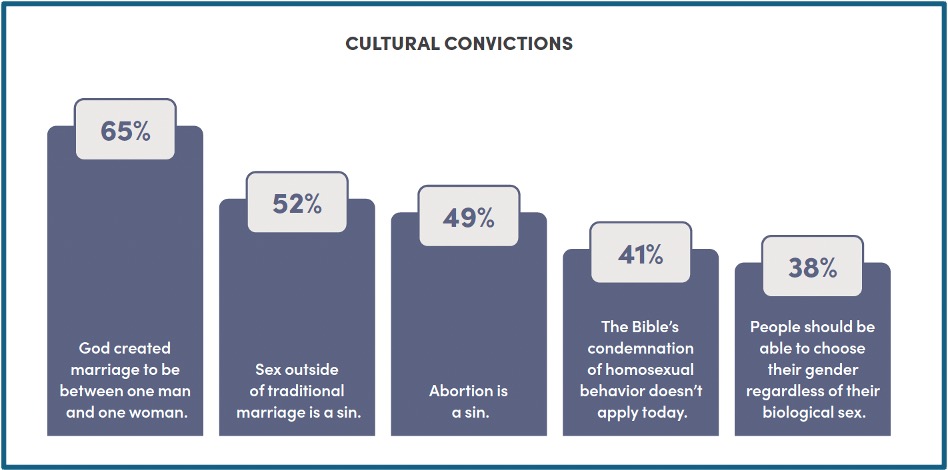
A crucial factor in understanding these statistics is to remember only about half of Americans believe the Bible is 100% accurate in all it teaches. This belief means holding to the doctrine of the inspiration of Scripture, that the Bible is “God-breathed” (2 Timothy 3:16). “While human authors wrote the individual books of the Bible, they were guided by the Holy Spirit to record God’s Word without error.” Whether in matters of faith, history, or morality, the Bible is without error in all it affirms. And it can be trusted in what it says on matters dealing with marriage, sex, abortion, homosexual behavior, and gender identity.
If the Bible is truly God’s Word, then it must be free from error because God Himself is perfect and incapable of lying (Titus 1:2). If the Bible contains errors, it would cast doubt on its claim to be the authoritative Word of God. However, the consistent testimony of Scripture is that it is trustworthy in all it teaches.
If only half of Americans believe the Bible has the authority to tell us what we must do in matters of faith, history or morality, these statistics on cultural convictions are less disconcerting. Many Americans don’t turn to Scripture for cultural, moral guidance. Some of the research done by the Barna Group on Evangelicals is helpful here.
Barna’s Evangelicals
In 2006, the Barna Group found that 45% of Americans were “born again,” meaning they have made a personal commitment to Jesus Christ that is still important in their life today, and who also believe that when they die, they will go to Heaven because they have confessed their sins and accepted Jesus Christ as their savior. Evangelicals are born again, but also met seven core beliefs taught in the Bible. They represent 9% of the adult Americans.
“Evangelicals” meet the born again criteria … plus seven other conditions. Those include saying their faith is very important in their life today; believing they have a personal responsibility to share their religious beliefs about Christ with non-Christians; believing that Satan exists; believing that eternal salvation is possible only through grace, not works; believing that Jesus Christ lived a sinless life on earth; asserting that the Bible is accurate in all that it teaches; and describing God as the all-knowing, all-powerful, perfect deity who created the universe and still rules it today.
George Barna noted while 85% of adult Americans viewed themselves as Christian, only 45% considered themselves to be born again. Then a mere 9% of the Americans surveyed were evangelical, meaning they met the above criteria defined by the Barna Group. Being a “Christian” in modern America is therefore more of a cultural label and has very little to do with adhering to Evangelical beliefs of the past 150 years.
The conclusion of The State of Theology 2025 invited its readers to pause and consider what these findings mean. “The research points a vivid picture of the beliefs, doubts, and spiritual questions present in American culture today.” The authors hoped it would inspire their readers to listen well, teach faithfully, and proclaim the gospel with renewed confidence. “The spiritual landscape is always changing, but the opportunity to point people to Jesus remains constant.”
For more information on the Barna Group’s examination of Evangelicalism, see “What is an Evangelical?” For a discussion of the 2016 State of Theology by Lifeway Research,see “What Americans Believe.”