Five years ago, on March 13, 2020, at 9:24 pm, Kenneth Copeland said God spoke to him and said: “COVID-19 will be over much sooner than you think.” This evolved into him decreeing the end of COVID-19, where he blew it away and saved the world—well, maybe not. But Kenneth Copeland isn’t the only person who believes that Christians have the power to “decree and declare” that something will happen. Whether they realize it or not, this decree and declare formula has similarities to voicing magical incantations.
Where did this belief that words can create reality come from? How did Christian speech shift from biblical prayer to a mystical technique in decree and declare theology? In “Spoken Into Being: How the NAR Turned Prayer Into Pagan Sorcery,” the Leaving the Message YouTube channel suggested the idea isn’t new; it’s ancient. “For thousands of years, cultures across Egypt, Babylon, and Gnostic sects taught that words themselves, spoken with intent, could shape reality, manipulate spiritual realms, or command divine power.”
In ancient Egypt, creation was not imagined as a physical struggle, but as an act of verbal precision. Among the earliest Egyptian deities, Ptah was believed to form the world not with tools or force, but through his heart and tongue. Egyptian priests in Memphis recorded this belief in a theological document known today as the Memphite Theology, inscribed on what is called the Shabaka Stone. According to this text, Ptah created the universe by first forming ideas in his heart, representing intention, and then speaking them aloud with his tongue. . . In Egyptian belief, speech had literal power. It was thought by uttering certain words, priests could activate divine forces, preserve order, or even animate lifeless objects.
Speech became an instrument of power and shaped Egyptian culture. “Language was not relational, as in prayer, but mechanical and effectual.” When the right words were spoken in the right order, they could compel spiritual outcomes. Here, the human mouth became a kind of tool; “one the didn’t depend on divine permission, but instead functioned according to hidden principles of the universe.” Listen to the video for more information on the pagan origins of decreeing and declaring.
The Declare and Decree Movement
In “What does it mean to decree and declare,” Got Questions said this belief has Pentecostal/Charismatic roots and is similar to the positive confession teaching practiced by Copeland and others in the Word of Faith movement. “To ‘declare’ is to state (out loud) a fact; to ‘decree’ is to issue an authoritative command.” Kenneth Hagin, acknowledged as a pioneer in the Word of Faith movement, wrote and said: “You Can Have What You Say.” Hagin thought we always get in life what we believe for and what we say. Christians who accept the decree and declare teaching, believe there is something powerful associated with our thoughts and words because we are made in the image of God.
The “decree and declare” movement claims to be biblical by using scriptural support. Since mankind is made in the image of God (Genesis 1:27), then, the thinking goes, we, like God, can speak and make things happen. God spoke things into existence (Genesis 1:3, 6, 9, 14, 20, 24, 26), so those with faith can do the same. Those who follow the “decree and declare” formula make such statements as “I decree and declare that I will be healed from my sickness” or “I decree and declare my family will be healthy and well provided for.” Often, asking God for things in prayer is replaced by decreeing those things to happen.
However, being made in the image of God does not mean we have the same abilities that God has. “Being made in the image of God means that we reflect God’s attributes, not that we can do the things that only God can, such as speak things into existence.” There is nothing biblical about blowing COVID-19 away. It’s nothing more than attempting to manipulate events to bring something to pass.
NAR Use of Psalm 91 During COVID
On March 21, 2020, a week after Kenneth Copeland supposedly heard from God, Holly Pivec commented in her blog that it was interesting that, despite their alleged miraculous powers, NAR leaders didn’t predict the coronavirus and weren’t able to stop it. After examining their responses to the virus, she noticed a pattern to what they said. The “prophetic proclamation” of Psalm 91 was said to be the key to breaking the grip of COVID-19 and launching a worldwide revival. “The theological idea behind it is that God’s children have the authority to create or alter reality through their spoken words, similar to the way God created in Genesis 1.” She then did a brief survey of what some of the key leaders of the NAR said about Psalm 91 and COVID.
Bill Johnson of Bethel Church in Redding California preached verse by verse on March 15th 2020 from Psalm 91, giving his understanding of how the psalm applied to the circumstances they found themselves in with COVID. Before reading the psalm, he said it was a well-known psalm because of its elements of safety and protection. He thought there were specific truths the Lord wanted them to take hold of, especially considering what was going on around the world then. “Today is supposed to be the start of a revival series. But we’re going to restart; this is what I’m doing.” Seemingly referring to the psalm, he then said: “This is revival-flavored antivirus software!”
Listen to the sermon if you want to hear how he applied the psalm to their circumstances. By the way, Bethel wasn’t meeting in person at this time; only online.
Shawn Bolz gave a prophecy about the end of the coronavirus. He told Fox News, “It’s not going to be the pandemic that people are afraid of.” That was less than two weeks before the World Health Organization confirmed in fact the coronavirus was indeed a pandemic. Not only was Bolz’s prophetic word not true, since then he has been widely condemned as a false prophet who used data mining in his “prophetic” utterances (Shawn Bolz and false prophets).
Cindy Jacobs, widely viewed as a prophet by those in the NAR, called on Christians to “pray Psalm 91 over your families and nations.” And she urged Christians to decree the virus will cease worldwide, with God healing all who are affected by it. According to her, there were many prophets in agreement that a great, worldwide spiritual awakening was coming, and demonic forces were using the coronavirus to delay or disrupt the coming revival. “God wants this season to turn into a catalyst of revival instead of contagion.”
Doug Addison, commissioned as a prophet by “apostle” Che Ahn, said God revealed to him that the coronavirus was a “direct attack” against the coming revival foretold by many of today’s so-called prophets. Addison said the enemy (the devil), was trying to prevent public meetings and cause fear of coming together. But this was a temporary storm that will blow over and “usher in a coming move of God.” He advised decreeing Psalm 91:7, that says: “A thousand may fall at your side, ten thousand at your right hand, but it [plague] will not come near you.”
Pivec said this was just a sampling from key players of the NAR. Their teaching about COVID-19 was contingent on the belief that God promised a great, end-time revival under the leadership of present-day apostles and prophets. “They’re also contingent on the idea that Christians have been given the authority to alter reality with their spoken words.” In a follow up blog article, Pivec said the wrong way to “pray Psalm 91” was to “decree” or “declare,” using a magical, name-it-and-claim it understanding of how to pray. “The right way to ‘pray Psalm 91’ was to believe the words of the psalm and have a peaceful confidence in God, trusting him to protect us as we go about doing his will.”
So, let’s look at Psalm 91 to see what it says and how it should be understood and used in prayer.
A Biblical Understanding of Psalm 91
A Handbook on the Book of Psalms summarized what Psalm 91 was about nicely: “This psalm is a meditation, in a serene and confident mood, on the security of the person who trusts in God.” We’ll look at two commentaries on the Psalms, written by Derek Kidner and Tremper Longman. In both discussions, there is no indication they thought the psalmist was making a “prophetic proclamation.” Nor did they interpret Psalm 91 as saying the theological idea behind it was that God was saying his children had the authority to create or alter reality through their spoken words.
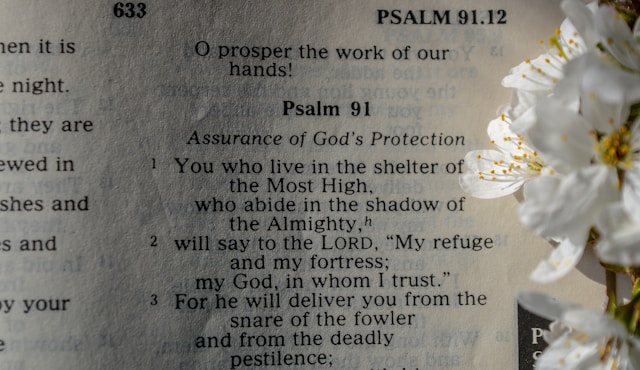
Psalm 91
He who dwells in the shelter of the Most High
will abide in the shadow of the Almighty.
2 I will say to the Lord, “My refuge and my fortress,
my God, in whom I trust.”
3 For he will deliver you from the snare of the fowler
and from the deadly pestilence.
4 He will cover you with his pinions,
and under his wings you will find refuge;
his faithfulness is a shield and buckler.
5 You will not fear the terror of the night,
nor the arrow that flies by day,
6 nor the pestilence that stalks in darkness,
nor the destruction that wastes at noonday.
7 A thousand may fall at your side,
ten thousand at your right hand,
but it will not come near you.
8 You will only look with your eyes
and see the recompense of the wicked.
9 Because you have made the Lord your dwelling place—
the Most High, who is my refuge—
10 no evil shall be allowed to befall you,
no plague come near your tent.
11 For he will command his angels concerning you
to guard you in all your ways.
12 On their hands they will bear you up,
lest you strike your foot against a stone.
13 You will tread on the lion and the adder;
the young lion and the serpent you will trample underfoot.
14 “Because he holds fast to me in love, I will deliver him;
I will protect him, because he knows my name.
15 When he calls to me, I will answer him;
I will be with him in trouble;
I will rescue him and honor him.
16 With long life I will satisfy him
and show him my salvation.”
In his commentary on Psalms 73-150, Derek Kidner said Psalm 91 was a psalm about danger; for times of “exposure and encirclement or of challenging the power of evil.” He marked the divisions of the psalm as My refuge (91:1, 2); Your pledge (91:3-13); and God’s pledge (91:14-16). Kidner noted changes of person from ‘I’ to ‘you’ and then to the divine ‘I’ as marking the divisions of the psalm and suggesting the three main headings. He said the psalmist declared his own faith in verse two, by declaring that God was “My refuge and my fortress, my God in whom I trust.” The protection for us is individual (7-11), and miraculous (11-13).
On God’s side, the eight expressions in 14–16 for what he undertakes are not only eight aspects of the whole. There is perhaps a certain progress traceable from the thought of his initial deliverance to that of his abiding companionship (‘with him’) and crowning gifts of glory, length of days (1b; see on 23:6, end) and a salvation no longer waited for but seen. For the Christian, these last three gifts (cf., respectively, Rom. 8:18, 11, 23–25) reveal dimensions only occasionally evident to the saints of the Old Testament.
In his commentary on the Psalms, Tremper Longman said in Psalm 91 the psalmist, who seems to be a priest, assures the congregation that God is with them and will protect them from trouble. He added the trouble appeared to military, so the congregation was likely the army facing dangers in battle. “Thus, it is a psalm of confidence, but there are also similarities with wisdom thought, particularly in the idea that no harm will come to those who have a proper relationship with God.” Longman divided the psalm into four, as My protection (91:1-2), God will save you (91:3-8), No harm will overtake you (91:9-13), and I will rescue you (91:14-16).
Longman said metaphors of protection permeate the opening two verses. He pointed to where verse 2 introduced military metaphors of protection (refuge/fortress) appropriate for a song of confidence in the context of warfare. Because of God’s power and protection, the psalmist assured the congregation or army that God will save them in their present predicament, described as a snare and disease: “For he will deliver you from the snare of the fowler and the deadly pestilence” (vs. 3).
The psalmist thus assures the congregation that God will not let disease overwhelm them, nor will he allow the battle to destroy them. They are threatened at night in the camp and during the day in battle (v. 5). People will die in the battle, but not the faithful, only the wicked (vv. 7–8). After all, God will indeed protect them.
The psalm ends with an assurance that God will deliver and protect the one who knows God’s name, who hold fast to him in love. If they affirm that God is their refuge and make him their dwelling, then they will be spared from harm (v. 10). Not only will they avoid minor injuries (strike their foot against a stone), but the major danger represented by the wild animals. Not only will they survive the threat of the lion, cobra, and serpent, but they will dominate them (trample under foot). Longman said this may seem overly optimistic but reminds us that the Old Testament saw God as a Warrior who fought alongside his people.
Interestingly, Longman noted where the devil quoted verses 11-12 of Psalm 91 to Jesus (Matthew 4:6). The devil told “Jesus to throw himself off the highest point of the temple, assuring him that God’s angels will catch him.” But Jesus quoted Deuteronomy 6:16: “Do not put the Lord your God to the test.” Where Israel gave in to temptations in the wilderness, Jesus resisted them and showed he is the true Son of God, the true Israel. “Christians can pray Psalm 91, knowing God is with them in the spiritual battle of this life and that in Christ, God will give them eternal life.” They don’t have to decree and declare that no evil or plague will come near them.