
Drinking alcohol, even at low levels can bring health risks. However, most alcohol-related harm is the result of heavy episodic or heavy continuous alcohol consumption. An estimated 400 million people, or 7% of the world’s population aged 15 and over have alcohol use disorder. “Of this, 209 million people (3.7% of the adult world population) lived with alcohol dependence.” The World Health Organization (WHO) reported in June of 2024 that 2.6 million deaths were caused by alcohol abuse.
In 2024, 9.7% of Americans over the age of 12 had an alcohol use disorder. In the US, the National Center for Drug Abuse Statistics (NCDAS) reported 178,307 Americans die from the effects of alcohol in an average year. Every day, an estimated 488 die as a result of excessive alcohol use. Adults aged 35 to 64 accounted for 49.7% of deaths from excessive alcohol use.
In the report, you can look at alcohol abuse statistics by state. California (42.3), Texas (37.5) and Florida (36.2) have the highest number of average daily deaths from excessive alcohol intake. New Mexico has the largest alcohol-related death rate per capita (12.86 deaths per 10,000 adults). You can even look at data on alcohol abuse and death rates by state. Here, we will look at the statistics for Pennsylvania.
There was an annual average of 6,624 deaths in Pennsylvania attributable to excessive alcohol use. Most of these deaths (63.1%) were from chronic causes, like alcohol use disorder. Demographically, 67% of people who die from excessive alcohol use were male and 2.01% are under 21. “87.0% of deaths in Pennsylvania from excessive alcohol use are adults aged 35 years and older.” Pennsylvania’s average daily deaths from excessive alcohol intake was 18.1. The state’s per capita alcohol-related deaths 6.48 per 10,000 adults.
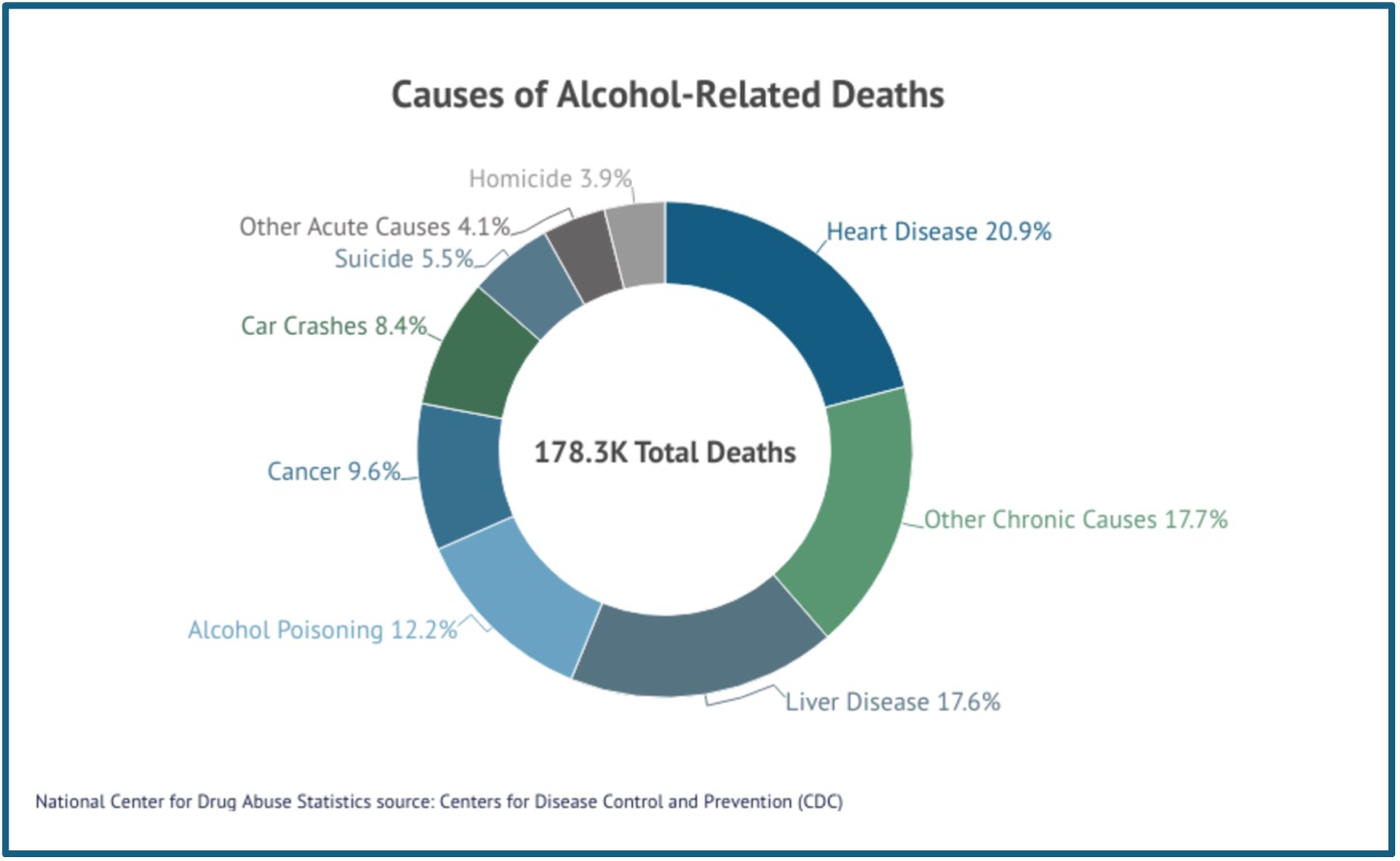
See the following graphic by NCDAS on data from the CDC on the causes of alcohol-related deaths. Notice where heart disease, liver disease and cancer are more frequent causes of alcohol-related deaths than car crashes, suicide, or homicide. We’ll take a closer look at the relationship between alcohol and cancer below, but here I want to point out that annual alcohol related deaths are greater than annual deaths from opioids, 178,300 to 80,000. This seems to suggest a closer look into the harms and deaths from alcohol is warranted. If you want to do a deeper dive into the statistics reported on the harms and deaths from alcohol globally or in the US, look at the linked reports.
A Major Global Health Challenge
In The Science of Addiction, Carlton Erickson said there is a great deal of evidence showing that genetic factors contribute to the risk of alcoholism, explaining 40-60% of the variance. But they don’t show a 100% risk of developing alcoholism, even with exposure to alcohol.
Having the genes for alcoholism does not mean the person will develop the disease (i.e., genes are not destiny). Implicit in these statistics is the fact that unknown nongenetic contributing factors account for the remaining 40-plus percent causes of alcohol dependence. The environment (in the broadest sense, ranging from too much drinking to factors in life that determine whether genes turn on or off) likely makes up the largest portion of these nongenetic contributing factors.
Just like many medical and psychiatric disorders, alcoholism is genetically heterogeneous (i.e., multiple genes and alleles are involved), with a variety of factors increasing or decreasing the risk.
Researchers from the Yale School of Medicine reported in the American Journal of Psychiatry on how alcohol use disorder (AUD) was a major global public health challenge. They said their findings show while genetics may play an important role, accounting for an estimated 50-60% of AUD risk, psychiatric and environmental factors explained most of the variance in AUD. Polygenic risk (a trait or condition influenced by multiple genes) was also a significant predictor. Polygenic risk scores (PRSs) were generated from genome-wide association studies of problematic alcohol use (PAU). They looked at 11,021 individuals in the Yale-Penn Study sample: “5,843 of African ancestry (AFR) and 5,178 of European ancestry (EUR).”
An article published by the Yale School of Medicine said the research team examined polygenic risk scores derived from large genome-wide association studies (GWAS), along with psychiatric conditions and environmental exposures, to assess both their independent and combined effects on AUD severity. “Polygenic risk scores for problematic alcohol use predicted AUD severity in both African- and European- participants, explaining 1.3% and 1.9% of the variance in this outcome, respectively.”
Among psychiatric disorders, posttraumatic stress disorder had the strongest association with AUD, “followed by anxiety and depression.” Environmental factors such as education, early household substance exposure, income and sex explained a larger proportion of risk, accounting for 73% of the variance in African-ancestry participants and 59% in European-ancestry participants. Interestingly, in European-ancestry participants, higher education moderated genetic risk, “suggesting that education may buffer genetic vulnerability to AUD.” One of the researchers said their findings show while genetics may play an important role accounting for AUD risk, “psychiatric and environmental factors account for the majority of alcohol use disorder risk that we can detect in a clinical context today.”
The study also highlights the role of social determinants of health, as African-ancestry participants in the sample were less likely to have higher education or household income, both of which were strongly linked to AUD risk.
The authors conclude that integrating genetic risk prediction with psychiatric and environmental risk factors provides a more complete understanding of the biopsychosocial origins of AUD. They emphasize that future prevention and treatment strategies must address both environmental and genetic determinants to be effective across populations.
No Alcohol Use Is Better
The journal Nature Health published “Health effect associated with alcohol consumption: a Burden of Proof study” in June of 2026. The research article said the relationship between alcohol and health was complex, and the evidence associating alcohol consumption and various cardiovascular disease, cancers and other conditions was evolving. Their findings indicated, “While potential health impacts at low-to-moderate levels varied by outcome, high levels of alcohol consumption were associated with increased risk across all outcomes.”
Their analysis observed moderate-to-strong harmful associations between alcohol and nine cancers, “of the pharynx, colorectum, larynx, lip and oral cavity, oesophagus, breast, liver, pancreas and prostate.” Together, they accounted for 5.6% of global deaths in 2021.
Despite strong evidence, public awareness of the link between alcohol and cancers remains considerably low, particularly for breast and colon cancer. This underscores an urgent need for clear, evidence-based communication about alcohol’s carcinogenic effects. While any level of alcohol consumption promotes cancer formation, our study has shown that low-to-moderate alcohol consumption is associated with a lower risk of cardiovascular diseases, type 2 diabetes, and Alzheimer’s disease and other dementias. Public health strategies for alcohol consumption should reflect this complexity.
Medical Xpress published an article titled, “One daily drink no longer looks harmless, as alcohol’s risks rewrite moderate drinking rules” on June 9, 2026. It reported on a study published in the Journal of Studies on Alcohol and Drugs that found a mortality risk from alcohol of 1 in 25 for people who consumed an average of 14 drinks per week. Drinking up to seven drinks per week was associated with only minimally elevate risks for most conditions. The lead author of the research article said even low levels of alcohol use come with risks. “And that risk continues to increase the more someone drinks.”
The study overturns a common misconception that alcohol can protect health. “We did not observe a significant protective effect of alcohol on health at any level of consumption,” says Shield [the lead author noted above]. “At low levels, alcohol may be associated with a reduced risk of ischemic heart disease and stroke. But when you look across the full range of health outcomes, including cancer and other chronic diseases, those potential benefits are outweighed by the risks even at seven drinks per week.”
Alcohol and Cancer Risk
Doing the research for this article raised my awareness of the risk of cancer from alcohol. In all the time I’ve worked with individuals with drinking problems, I can’t recall reading anything that clearly articulated how drinking even moderate amounts of alcohol raises your risk of cancer as the articles I read and referred to you here.
The CDC opened its article on “Alcohol and Cancer” with the statement: “You can lower your risk of cancer by drinking less alcohol or not drinking at all.” The listed kinds of cancer are: mouth, throat (pharynx), voice box (larynx), esophagus, colon and rectum, liver, and breast (in women). Each year, 20,000 adults in the US die from alcohol-associated cancers. “Studies show that alcohol may increase cancer risk in several ways.” Breast cancer is the most common alcohol-associated cancer among women, and colorectal cancer is the most common one among men.
Alcohol can disrupt cell cycles, increase chronic inflammation, and damage your DNA. DNA is the cell’s “instruction manual” that controls how a cell grows and does its job. When DNA is damaged, a cell can grow out of control and become cancer.
Alcohol can increase levels of hormones, including estrogen. Estrogen plays a role in breast cancer development.
Alcohol makes it easier for the cells in our mouth to absorb cancer-causing chemicals (called carcinogens). For example, when you use both alcohol and tobacco, the alcohol increases the absorption of carcinogens from the tobacco.
Medscape has been on a mission to rise awareness that alcohol causes cancer for a few years. They published an Educational Clinical Brief in 2016, “New Evidence Cites Alcohol an Causing Cancer in Seven Sites,” repeating the seven kinds of cancer noted in the CDC article. It cited an article published in July 2016 in the journal Addiction, “Alcohol consumption as a cause of cancer.” The Medscape Educational and Clinical Brief said this was not news, as alcohol consumption has been causally associated with these 7 cancers for a long time.
Medscape quoted the author of “Alcohol consumption as a cause of cancer” as saying she wrote her review to clarify the strength of the evidence because there is confusion about whether alcohol causes cancer. “In the public and media, statements made by the world’s experts are often given the same weight as messages from alcohol companies and their scientists.”
Medscape has since that time published a series of articles on how alcohol causes cancer, including: “The Sobering Facts About Alcohol and Cancer,” “Alcohol and Pancreatic Cancer: New Evidence About Risk,” “Most Americans Unaware Alcohol Can Cause Cancer,” “Red Wine May Not Be a Health Tonic, but Is It a Cancer Risk?,” “ Heavy Drinking Tied to Young-Onset Pancreatic Cancer.”
The conclusion is simple: don’t drink alcohol. And if you do, realize there is no frequency level that will keep you from the potential health risks.