In May of 2025 the United Nations Office on Drugs and Crime (UNODC) gave a warning on the emerging analogues of brorphine, a potent synthetic opioid. Brorphine was first identified in 2019 to the UNODC Early Warning Advisory on NPS (new psychoactive substances) and became a Schedule I UNDC drug under international control in 2022. The DEA made it a permanent Schedule I drug in the U.S. in 2023 after receiving reports it was found in counterfeit opioid pills and tablets. Instead of quietly fading away, it morphed into several other orphine analogues, including one called chlorphine. This particular analogue, which is reportedly 50 to 200 times more potent than heroin, is widely referred to in public health communications as “cychlorphine.”
This class of drugs, the orphines, was first patented by Janssen Pharmaceuticals in 1967. Brophine was the first compound in the group to be reported. See Wikipedia for a “List of orphine opioids,” totaling 43 distinct orphine compounds. Originally intended as a potent new analgesic class of drugs, they were ultimately abandoned because of having severe safety concerns with a high abuse potential.
In recent years orphines have emerged as designer drugs. Pharmacy Times said in 2018 when the DEA implemented class wide scheduling of fentanyl-related substances, illicit manufacturers were prompted to use alternative compounds such as orphines. They behave as strong agonists at the μ-opioid receptor like fentanyl, but have a greater potency. “Preliminary toxicological analyses indicate that some analogues may exceed fentanyl potency multiple-fold, increasing the likelihood of rapid-onset overdose.”
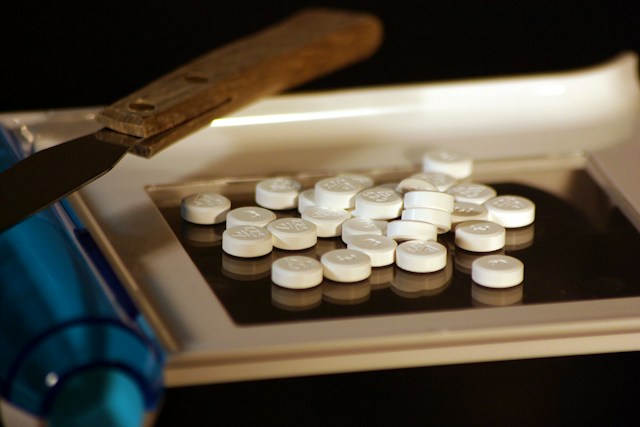
Brorphine generally acts as a full mu-opioid receptor agonist, with greater potency than morphine, and comparable or slightly lower potency than fentanyl. The substance has been identified in various drug sample forms: as powder, crystal, tablet or capsule form, including as falsified opioid medicines. Moreover, brorphine has been associated with serious adverse effects, including deaths. In 2023 and 2024, six post-mortem and two clinical admission cases involving brorphine were reported to the UNODC EWA Tox-Portal from North America. Polysubstance use was evident in all these cases, involving two or more other NPS. With no known therapeutic use, brorphine poses a significant risk to public health and safety.
Cychlorphine: Coming to an Area Near You
The CDC described three waves to the opioid epidemic. The first wave began in the 1990s with the increased prescribing of opioids. Overdose deaths from prescription opioids increased beginning around 1999, but have declined in recent years. For more information on this first wave, see “Giving an Opioid Devil Its Due.” The second wave began in 2010, with rapid increases in overdose deaths from heroin, as opioid users transitioned to the lower cost of heroin than prescription opioids. The third wave began in 2013, when overdose deaths began to involve illegally made fentanyl and fentanyl analogues (IMFs).
IMFs have largely saturated the illegal drug supply. They are often found in powder form or pressed into counterfeit pills and can have other drugs mixed into them. More recently, non-opioid sedatives, such as xylazine, have been found mixed into IMFs.
The Journal of Pain Research also said the U.S. opioid crisis has gone through successive waves, each driven by the displacement of one chemical class of illicit drug by the next. Fentanyl and its analogues dominated the third wave. Nitazines, first synthesized in the 1950s, gained traction from 2019 onward. But after the Chinese government scheduled nitazine analogues in July 2025, the orphine analogues noted above emerged, especially cychlorphine.
There has been in effect a media explosion of warnings about cychlorphine, or N-propionitrile chlorphine, around the end of September 2026. News and media organizations from across the country were warning about the presence of this “new deadly synthetic drug.”
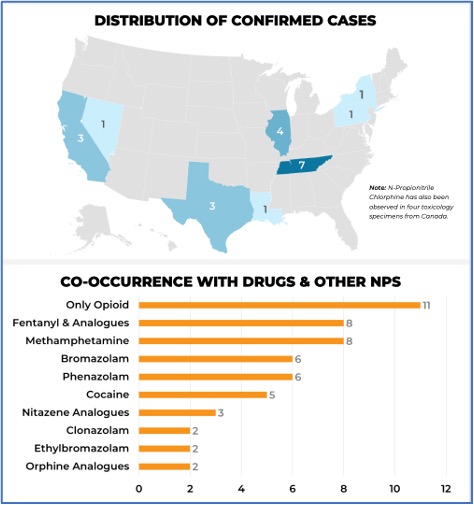
The first reported US detection of cychlorphine by the DEA occurred in April 2024 in Florida. By the end of February 2026, DEA labs had identified it in 22 different national samples. “As of March 2026, at least 24 states have reported overdoses or deaths linked to cychlorphine, including a cluster of 19 confirmed deaths in East Tennessee, and detections in Illinois, Ohio, Kentucky, California, and Texas, among others.” Co-detected substances included fentanyl, oxycodone, methamphetamine, cocaine, novel benzodiazepines and carfentanil.
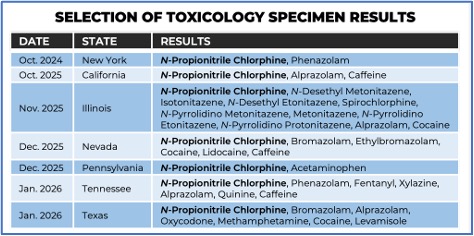
The Center for Forensic Science Research & Education (CFSRE) reported cychlorphine was identified in 25 blood specimens from fatal overdoses tested at the CFSRE in late-2025 and early-2026. Toxicology specimens came from 8 states across the U.S. Cychlorphine was the only opioid in 11 of 25 cases, and alongside other opioids and stimulants in the other ones. See the following graphics from the CFSRE public alert.
This polydrug context complicates both the presentation and management of overdoses. Cychlorphine is currently not federally scheduled in the U.S., but was recommended for placement as a Schedule I drug on July 1, 2026. “Its high potency, structural novelty, and detection limitations in standard toxicology screens call for urgent awareness by the clinical, forensic, and public health communities.”
Discover Magazine said the Office of National Drug Control Policy (ONDCP) issued a statement in April of 2026 that cychlorphine was found in all four U.S. Census regions, with the highest prevalence in Ohio, Texas and Tennessee. “By the end of 2025, cychlorphine was identified over 100 times in drug samples across 10 states, compared to only one report in 2024.” The danger with cychlorphine and other orphine synthetic opioids is that they’re mixed with other substances and falsely identified as a different drug or medication. See the toxicology specimen chart above. An additional problem is drug test strips and routine hospital urine screens for opioids are not able to detect cychlorphine and the death toll is adding up.
ONDCP published a notice on April 30, 2026 that said at least 41 overdose deaths between July 2025 and February 2026 were linked to cychlorphine. Nationally there have been 55 deaths linked between 2025 and 2026. The Big Issue reported cychlorphine was associated with five overdose deaths in England. It was linked to approximately 50 overdose deaths in Eastern Tennessee, and an overdose death in San Francisco in April of 2026. The decedent in San Francisco was believed to have ingested counterfeit pills containing cychlorphine as well as “ethyl bromazolam, a benzodiazepine that is not approved by the FDA.” Counterfeit pills may look like prescription medications, but contain unknown and potentially deadly substances. “There is no way to tell from appearance alone whether a pill is safe. Even a fraction of a counterfeit pill can kill someone.”
The San Francisco Standard said there is a dilemma for health officials. When you warn people about a drug that can be 10 times stronger than fentanyl, you advertise it to those for whom fentanyl no longer works. One person said: “Us being addicts, we’re like, ‘Let’s go try it.’”
Chinese authorities recently announced a ban on orphine chemicals. According to some studies, a previous ban by the Chinese government on the sale on chemicals used to make fentanyl was linked to disruptions in the sale of the drug. But one expert said, “You restrict it, and then they just move on to the next thing … Then you have to do it all over again.”
The above linked “List of orphine opioids” suggests not only do we need to become aware of and address the growing dangers from cychlorphine, but be ready for which orphine, or other opioid, will pop up next in this deadly game of whack-an-opioid we seem to be playing.