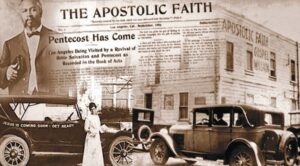
Within the modern charismatic and Pentecostal movement there are churches holding to a tripartite understanding of human nature that wrongly believe God can bypass our soul/intellect and communicate directly with our spirit. This seemed to develop from a so-called “revolt” against the suppression of the spirit in Protestant theology and a strained understanding of trichotomy. Here, we will examine how an unbiblical tripartate view of human nature developed from the teachings and experiences of early Pentecostal leaders and became entrenched in the theology of the NAR, New Apostolic Reformation.
What it means to be human has been a central question in science, philosophy and religion for centuries. Despite the lively debate, and opinions of many of the most brilliant minds in human history, there is no settled opinion on what it means to be human. In its article on “Human nature,” Wikipedia noted where discussions about human nature typically weighed the comparative importance of genes and environment in human development; in other words, nature versus nurture. Here, we’ll examine how theology can influence how you understand human nature by asking, “What is man that you are mindful of him?” (Psalm 8:4).
“What is man?” is a question echoed in several additional Biblical passages such as Psalm 144:3, Job 7:17, and Hebrews 2:6. The New Dictionary of Theology said the Bible’s reference to the human nature must be recognized as occurring within the context of our place in creation and our standing before God. It cannot be answered without reference to the doctrine of creation—human beings as creatures made in the image of God.
We are not emanations emerging from the being of God himself, but a part of the total created order that is wholly distinct from God. Neither did the human race evolve as a product of an independent process of ‘natural’ selection and development. Rather humanity is portrayed biblically, as the special and direct creation of God.
In Genesis 2:7, it says: “Then the Lord formed man of dust from the ground and breathed into his nostrils the breath of life, and the man became a living creature.” The Hebrew word translated here as “creature” (nep̄eš) in the ESV can also mean life, soul, person, appetite or mind, according to the Theological Word Book of the Old Testament. According to The New Dictionary of Theology, nep̄eš is often translated by the English word ‘soul,’ as it does in the KJV— “and man became a living soul.” But this understanding suggests the influence of Hellenistic thought, and should rather be “understood in its own context within the OT as indicative of men and women as living beings or persons in relationship to God and other people.”
The Septuagint translated the Hebrew word here in Genesis 2:7 with the Greek word psyche (soul), which helps explain the custom of understanding the OT use of nep̄eš in the light of the Greek word psyche. But this should be reversed, according to The New Dictionary of Theology. “It is surely more appropriate to understand the use of psyche (in both the LXX and the NT) in the light of the OT’s use of nep̄eš.” The human person is a ‘soul’ because it was a ‘body’ made alive by the breath or Spirit of God. This suggests that any conception of the soul as a separate part or division within our being is invalid, as when theorizing humans as bipartite or dichotomy (body and soul/spirit) or tripartite or trichotomy (body, soul, and spirit) beings.
The Psychsomatic Unity of Human Nature
In Created in God’s Image, Anthony Hoekema said one of the most important aspects of a Christian anthropology was to see humans in their unity, as whole persons. Human beings have been described as distinct parts abstracted from the whole. “So in Christian circles, man has been thought of as consisting either of ‘body’ and ‘soul’ [dichotomy] or of ‘body,’ ‘soul,’ and ‘spirit’ [trichotomy].” He noted since the Bible uses terms like soul, spirit and heart more or less interchangeably, its not possible to construct an exact biblical psychology.
According to Hoekema, the biblical use of soul, spirit and heart typically refer to the whole person. Whether in the Old or New Testament, soul and spirit are often used interchangeably. The word ‘heart’ also describes the whole person in both the Old and New Testaments. “The human person must be understood as an embodied soul or a ‘besouled’ body. He or she must be seen in his or her totality, not as a composite of different ‘parts.’ This is the clear teaching of both the Old and New Testaments.”
While a human being is one person, they can be looked at from two sides. Hoekema thought we should speak of humans as psychosomatic unities— psyche (soul) and soma (body). “The advantage of this expression is that it does full justice to the two sides of man, while stressing man’s unity.” For a more detailed discussion of Hoekema’s understanding of humans as created, whole persons, see “Created in the Image of God? Part 2.”
The Death and Rebirth of Trichotomy
In Systematic Theology, Louis Berkoff said while it has been customary in Christian circles to think of man as consisting of a dichotomy with two distinct parts, body and soul, the trichotomic view had considerable favor with the Greek or Alexandrian Church Fathers. In its crudest form, trichotomy held the body to be the material part of human nature, the soul to be the principle of animal life, and the spirit as the God-related rational and immortal element of man. Although not in the same form, it can be found in the writings of Clement of Alexander, Origen, and Gregory of Nyssa. “But after Apollinaris employed it in a manner impinging on the perfect humanity of Jesus, it was gradually discredited.” The psychology of Augustine was especially persuasive for dichotomy, and during the Middle Ages, it became a matter of common belief.
But trichotomy would be “born again” as a result of a philosophical movement called German idealism in the late 18th and early 19th centuries. German idealism or post-Kantian idealism developed out of the work of Immanuel Kant in the 1780s and 1790s. The movement was closely linked with Romanticism and the Enlightenment. “The movement is best understood as a manifestation of the modern demand for rationality and freedom.”
Kant was attempting to reconcile the empirical thinking of David Hume with the rationalism of Leibniz and Spinoza. His skepticism challenged the fundamental tenets of the Enlightenment by arguing that reason was subordinate to custom and habit, and that free will was an “unattainable fantasy.” Kant’s transcendentalism affirmed the mind was not a passive recipient of sensory information, but actively structured our experience of the world through acts of ‘spontaneity.’ “His work, however, limited knowledge to appearances (phenomena) and left the nature of things as they are in themselves (noumena) unknowable. In The Holy Spirit in Christian Theology, Princeton theologian George Hendry said:
The development of the philosophy of spirit in post-Kantian idealism, originating in Germany, may be interpreted historically as a revolt against the suppression of the spirit in Protestant theology; for it was in its initial intention an affirmation, or reaffirmation, of the human spirit.
Hendry seems to say post-Kantian idealism led to a belief that Protestant theology had suppressed the expression of the spirit. This resulted in the work of the Spirit being equated with “the vitality of some religious experience.” We see this in the revivalism of the 19th century and the emergence of Pentecostalism at the beginning of the 20th century. It also contributed to a major resurgence of interest in the tripartite view of man during the 19th century.
In the Wikipedia article on “Tripartite (theology)” there is a chart that listed many philosophers and theologizers of the 19th century whose works supported trichotomy, including Søren Kierkegaard, Franz Delitzsch, Andrew Murray, John Bickford Heard, Watchman Nee, and C. I. Scofield, author of the Scofield Reference Bible. Berkoff said this resurgence was not met with great favor in the theological world.
The recent advocates of this theory do not agree as to the nature of psuche, nor as to the relation in which it stands to the other elements in man’s nature. Delitzsch conceives of it as an efflux of the pneuma, while Beck, Oehler, and Heard, admit that the Biblical representation of man is fundamentally dichotomic. Their defense of a Biblical trichotomy can hardly be said to imply the existence of three distinct elements in man. Besides these two theological views there were, especially in the last century and a half, also the philosophical views of absolute Materialism and of absolute Idealism, the former sacrificing the soul to the body, and the latter, the body to the soul.
Trichotomists believed that in Genesis 2:7, when God breathed the breath of life into man, it became man’s human spirit. Franz Delitzsch (1813-1890) said in Biblical Psychology, “He then breathed into this form the creature spirit, which, because it originated after the manner of breathing, may just as well be called His spirit as man’s spirit, because it is His breath made into the spirit of man.”
In the Tripartite Nature of Man, John Bickford Heard (1828-?) said Genesis 2:7 was a revelation of man’s threefold nature. “It is clear that the breath is here of the same nature as the Being who breathes it.” Heard said there were three points in the verse that suggested the threefold nature of man. The dust of the ground was the material cause, the breath into his nostrils was the formal or efficient cause, and man becoming a living soul was the final cause.
Heard’s description here applied the four causes of Aristotelian thought: material cause, formal cause, efficient cause, and final cause to understanding human nature. This further explains the above comment by The New Dictionary of Theology on the influence of Hellenistic thought in interpreting Genesis 2:7. Aristotle wrote, “we do not have knowledge of a thing until we have grasped its why, that is to say its cause.”
Got Questions said it may not be important for Christians to decide whether dichotomy or trichotomy represents their understanding of what Scripture says about human nature. But they cautioned that some who hold the trichotomist view have wrongly taught that God can bypass our soul/intellect and communicate directly with our spirit—“such teaching leads to irrational mysticism.” And I’d say it also contributed to many of the chaotic practices in the NAR, including prayer declarations, the restoration of authoritative modern apostles and prophets, Christian tarot cards, and the practice of freeing Christians from so-called demon-possession or demonization.
Other churches have used the trichotomous position to teach the possibility of Christians being demon-possessed. Because they see the soul and spirit as two separate immaterial aspects within the Christian, they postulate that one can be indwelt by the Holy Spirit and the other can be possessed by demonic forces. This teaching is problematic in that there are no biblical references that those who are indwelt by the Holy Spirit can be simultaneously possessed by demons.
This “revolt against the suppression of the spirit in Protestant theology” would become experientially evident in the emergence of Pentecostalism at the beginning of the 20th century. It’s there we will find individuals espousing a trichotomist view that wrongly taught that God could bypass our soul/intellect and communicate directly with our spirit. This belief emerged from the teachings of early Pentecostal leaders like John G. Lake. See “John G. Lake and the Consequences of a Triune Human Nature” when it’s published in a few weeks.