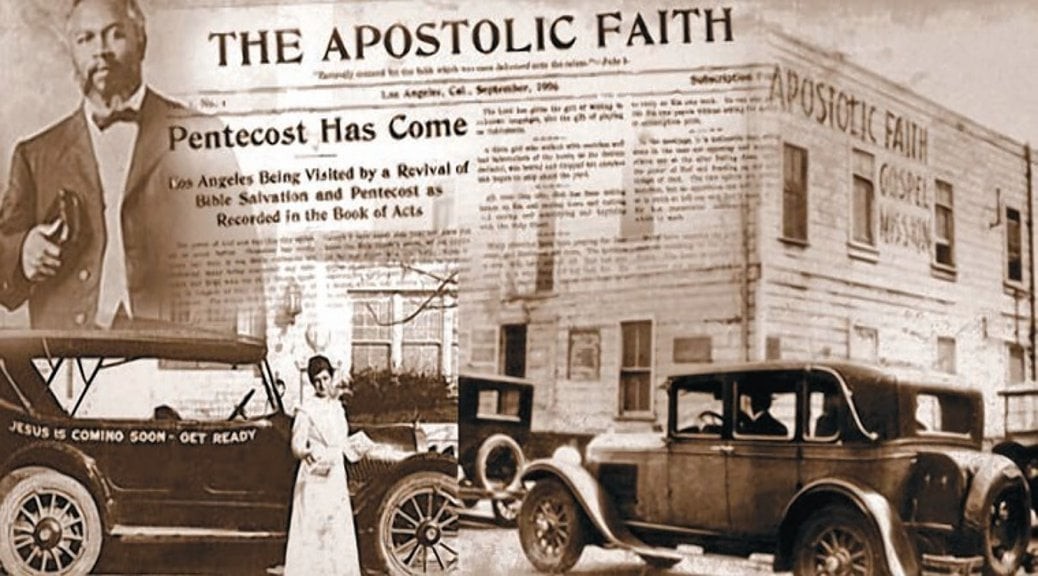
In “The Dark Side of the Azusa Street Revival,” John Collins said in order to understand the Azusa Street revival, you must first understand Charles Fox Parham. He was the person who trained William Seymour in revival culture, the end of days focus, and the apostolic faith. Although Parham is known by many as the father of modern Pentecostalism, you won’t find him called that by Pentecostal-leaning historians. “Because they want to totally erase that history.”
“Azusa Street in Flames: Earthquake, Ecstasy, and the Birth of Pentecostal Chaos,” said the Azusa Street Revival of 1906-1909 became widely regarded as “the catalytic event of modern Pentecostalism.” It transformed a small Holiness mission led by William Seymour into a global center for teaching on “Spirit baptism,” speaking in tongues, and divine healing. “From this modest, interracial congregation, visitors carried Pentecostal doctrines and practices across North America and overseas, planting churches and founding denominations that would define twentieth-century Pentecostal identity.”
Later movements such as the Latter Rain, and Charismatic Renewal imported the Pentecostal experience into mainline Protestant and Roman Catholic churches; and eventually into the New Apostolic Reformation. Explicitly or implicitly, they appealed to Azusa Street as proof that God was restoring apostolic authority, miracle ministries, and end-time “kingdom” advance. “In this sense, Azusa Street stands not only as a historical event but as a continuing symbolic touchstone for successive waves of revivalism that trace their lineage to its theology, spirituality, and mythology.”
In Initial Evidence, Cecil Robeck noted that in January of 1901 some of Charles Parham’s students in Topeka Kansas had begun to speak in tongues, which Parham said was “the Biblical evidence” of the baptism of the Holy Spirit (See, “Holy Spirit Baptism and Speaking in Tongues”). William Seymour enrolled in Parham’s Houston Bible school in 1905, and quickly embraced Parham’s theory of “the Biblical evidence.” Because of “Jim Crow” segregation laws, he had to learn by sitting in the hall outside the classroom.
Parham was implicated in a scheme that swindled money from investors though a product advertised as able to transform rocks into gold. Evidence suggested he used those funds for his Topeka Kansas school and commune. He was an outspoken supporter of the Ku Klux Klan, praising what he said were “there high ideal for the betterment of mankind.” He was also a convert to British Israelism. He later taught British Israelism to Wesley Swift, who then developed in into the Christian Identity doctrine. This would later be repackaged by William Branham as his “Serpent’s Seed Doctrine.”
The Earthquake and Azusa Street
Through a series of circumstances, Seymour was invited to pastor a church in Los Angeles, and he moved there to do so in February 1906 with Parham’s approval. At his first church meeting in LA, he “expounded Parham’s view of baptism with the Holy Ghost, including the claim that speaking in tongues was ‘the Biblical evidence.’” The mission was promptly padlocked by church leaders and he was told not to preach the doctrine any longer.
But Seymour was invited to lead a prayer and Bible study in someone’s home, where he continued to teach that speaking in tongues was the Biblical evidence of baptism with the Holy Ghost. On April 9th, five weeks after he was locked out of his LA church, several people began to speak in tongues. The group rented an old building at 312 Azusa Street and formed a new congregation on April 17th. Then the San Francisco earthquake occurred. “Azusa Street in Flames” said:
On April 18, 1906, the San Andreas Fault violently shifted, setting the city of San Francisco ablaze. In the days that followed, religious alarmists throughout Los Angeles began claiming that judgment had struck the West Coast and that the wrath of God was about to consume the nation. As a result, Holiness groups far and wide began churning out tracts and pamphlets warning that the End of Days was near. By evening, news of William J. Seymour’s new revival on Azusa Street had reached the newspapers. The Los Angeles Times ran a front-page article describing a “New Sect of Fanatics” that was “Breaking Loose” with a “Weird Babel of Tongues.”
The Los Angeles Times described what was happening at the mission as a racially mixed religious disturbance “marked by noise, disorder, and excess.” The description characterized what was happening there with racial slurs, collapsing a critique of the new ‘tongues’ movement at Azusa Street into “a racialized spectacle and a threat to social order.” Many Holiness and evangelical critics saw what was happening as religious fanaticism rather than a genuine work of the Holy Spirit.
Nevertheless, many local Holiness churches began to join Seymour’s ‘revival’ at Azusa Street. Akin to the modern events known as the Toronto Blessing and Lakeland Revival, at Azusa Street these groups began exhibiting ‘holy jerks,’ ‘holy laughter,’ ‘holy dancing,’ ‘singing in the spirit, ‘speaking in tongues,’ and more so-called spiritual manifestations. Non-Christian groups came to Azusa Street as well. Holiness converts found themselves standing next to spiritualists, mediums, and members of occult societies. The Azusa Street revival became home to “occult séances and trances mixed with strangely similar ‘Christian’ séances and trances.”
One visitor described the revival as pure chaos. Men and women were shouting, weeping, dancing, falling into trances, speaking and singing in tongues, all while “Elder” Seymour, the leader of the “revival,” rarely preached. Most of the time, Seymour kept his head covered by a packing crate behind the pulpit, a posture that his supporters interpreted as humility and prayerful dependence on the Spirit. When he was seen walking through the crowds, five and ten-dollar bills were sticking out of his hip pockets, where passersby had crammed them full of money. When he did preach, he hurled insults and challenges at anyone who did not accept his views. To those who embraced his “message,” Seymour would exclaim, “Be emphatic! Ask for salvation, entire sanctification, the baptism with the Holy Ghost, or divine healing!” This rhetoric reflects broader Holiness-Pentecostal emphases on a multi-stage spiritual experience and on visible manifestations as confirmation of divine favor.
Parham at Azusa Street
Seymour was disturbed and confused about what was happening at Azusa Street and he wrote letters to Parham for advice on how to tell occult ecstasy from Christian ecstasy. “While he waited for a response, hundreds of religious enthusiasts — Christian and occult alike — filled Azusa Street with noise and commotion twenty-four hours a day, seven days a week.” When Parham finally arrived in October of 1906, he was shocked to find the interracial unity of the revival. He condemned the crowding together around the altar, with people laying across one another “like hogs, blacks and whites mingling.” He said the interracial proximity at Azusa Street was evidence the meetings could not be of God.
Seymour’s converts saw Parham’s objections as threats. And some of them told Seymour Parham “Was not wanted.” Their anger intensified after Parham’s harsh statements against the hypnotists and spiritualists “who had taken over portions of the services.” Eventually, Seymour banned Parham from the revival meetings.
What had begun as an attempt by Charles Fox Parham to recreate a new sect modeled in part on the militaristic communal experiments of Reverend Frank Sandford and John Alexander Dowie’s colonies became a loose cannon that blasted Holiness sects and organizations throughout the country. Most of the people in the Holiness faith who visited the Azusa Street Revival returned to their cities convinced they had the “gift” and the ability to impart it to others. Many who attended, even for a short time, later founded entire Pentecostal denominations. Over time, a list of “pilgrims to Los Angeles” effectively became a “who’s who” of early Pentecostal leadership. One of those attending the Azusa Street Revival was F. F. Bosworth, who later rose to fame as a “faith healer” and worked closely with William Branham.
As a black preacher, Seymour was part of Parham’s efforts to reach black communities with his revivalism and teaching on tongues as the biblical evidence of the baptism of the Holy Spirit. In “The Dark Side of the Azusa Street Revival,” John Collins described how William Seymour initially worked with Charles Parham in building his apostolic faith missions, perhaps with Parham’s intent to form a denomination out of his missions. But this never happened because of scandals related to Parham and the split between Parham and Seymour.
The Decline of Parham’s Revivalism
Along with John G. Lake, Parham was implicated in what were called the “Parhamite murders” in Zion, Illinois in 1907. These were individuals who died as a result of brutal exorcisms performed on them by members of Parham’s sect of followers. One of the ladies Parham and the others were attempting to deliver had crooked bones from rheumatoid arthritis. They tried to eliminate the demon by straightening her bones “until they snapped” and the woman actually died. “All of this took place at the height of the Azusa Street revival.” But Parham was never implicated, as he had other troubles emerge in Texas, where he had been invited to lead revivals at the Majestic Theater in San Antonio.
In July of 1907, Charles Parham was arrested in front of junior members of the church meeting at the Majestic Theater. Newspaper accounts described a “mass of evidence” against Parham, including his own confession, when he was formally charged with sodomy. Affidavits, letters, and eyewitness testimony were introduced, “and it emerged that Parham had previously faced similar accusations in Waco, League City, and Orchard, Texas.” Parham did not deny the act, but said it occurred while he was asleep, and repeatedly said: “I am not guilty of intentional crime.” Parham was eventually erased from Pentecostal histories. Collins said he really wasn’t “somebody that you want to be the father of modern Pentecostalism.”
Unlike the early history of the Israelites in the Bible, the early history of Pentecostalism seems to have been sanitized to remove or ignore its warts and failures. William Seymour and Charles Parham both had a role in its inception. Their excesses do not negate what God was able to do despite them and through them. When reading the history of Pentecostalism, we need to pay attention to the fruit. A good tree bears good fruit, and a bad tree bears bad fruit; you will know a tree by it fruit (Luke 6:43-45).