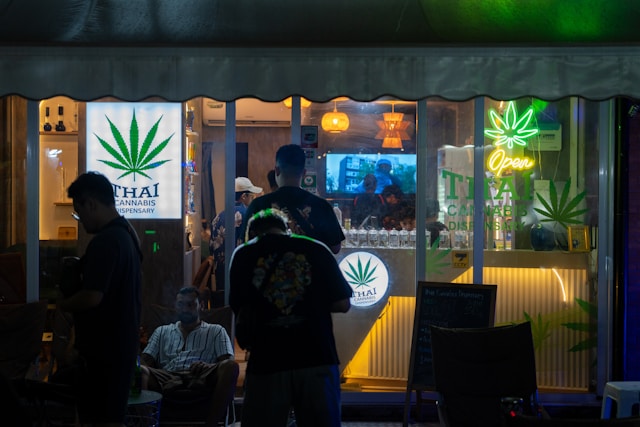
What could the impact be in Pennsylvania if recreational marijuana was legalized? We can look at states like Colorado where it was legalized in 2012 to see what happened there. There are a couple different reports we can look at, the first one by the Colorado Division of Criminal Justice: Impacts of Marijuana Legalization in Colorado. Data was available there on crime, traffic safety, and youth impacts.
Impact of Legalizing Marijuana in Colorado
The total number of marijuana arrests decreased by 68% between 2012 and 2019, with large decreases in possession and sales charges, but there was a slight increase (3%) in arrests for marijuana production. The total number of marijuana-related court filings declined 55% between 2012 and 2019, mostly by decreases in misdemeanors and petty offenses. The DEA made the highest number of arrests in 2018 and 2019 since legalization and seized the highest number of indoor plants in the past 14 years. The number of outdoor plants eradicated by the DEA varied, ranging from 29,655 plants in 2009, then 2,059 in 2017, followed by 4,247 outdoor plants in 2019.
DUI arrests involving marijuana increased from 12% of all DUIs in 2014 to 31% in 2020. The prevalence of marijuana-alone citations increased from 6.3% in 2014 to 8.7% in 2020. However, citations for marijuana-in-combination with alcohol or other drugs also increased from 5.7% to 22.7%. The number of traffic fatalities where the driver tested positive for any cannabinoid increased 140%, from 55 in 2012 to 132 in 2019.
There was no significant change in the past 30-day use of marijuana by middle and high school-aged youth between 2013 and 2019. Juvenile marijuana arrests decreased by 42%. School suspension rates related to drugs tended to fluctuate over time. School discipline data for 2019-20 indicated that marijuana infractions accounted for 30% of all expulsions and 34% of law enforcement referrals to Colorado public schools. The infractions were almost always for simple marijuana possession.
The Rocky Mountain High Intensity Drug Trafficking Area (RMHIDTA) yearly tracks the impact of legalizing recreational marijuana in Colorado. The purpose of the report was to provide data and information for policy makers to make informed decisions on marijuana legalization. Since recreational marijuana was legalized in 2013, past month use of marijuana among Colorado residents 12 and older increased 26% and was 61% higher than the national average, currently ranking 3rd in the nation. Traffic deaths where drivers tested positive for marijuana increased 138%, while all Colorado traffic deaths increased 29%. Sixty-six percent of local jurisdictions in Colorado have banned medical and recreational businesses. The latest published report was in 2021.
Medical and recreational marijuana legalization is destroying the health and social fabric of Colorado. Suicide, overdoses, ER visits, hospitalizations, and domestic and street violence due to cannabis are soaring while cannabis tax revenues are an anemic 0.98% of the 2021 state budget. Tax revenues are dwarfed by the Centennial State’s cost for law enforcement, automobile and industrial accidents, and increased school crime.
Teen Cannabis Use Doubles the Risk of Psychosis and Bipolar Disorder
There’s more news about problems stemming from adolescent cannabis use. A recent study published in the JAMA Health Forum looked at the possibility of increased risk of mental health disorders with adolescent cannabis use. The study screened over 460,000 adolescents aged 13 to 17 for their cannabis use. Past year use was associated with a significant increased risk of incident for psychotic, bipolar, depressive, and anxiety disorders by the age of 26. “The strongest associations were found for psychotic and bipolar disorders, which is consistent with prior research suggesting that cannabis use during adolescence may be an especially strong risk factor for severe psychiatric outcomes.”
These findings complement longitudinal epidemiologic studies that have found that adolescent cannabis use is associated with increased risk of psychotic experiences and adult psychotic disorders, as well as experimental studies that have reported an increase in psychotic experiences after intravenous tetrahydrocannabinol (THC) exposure, A recent population-based cohort study in Ontario, Canada, found that the risk of developing schizophrenia associated with CUD [cannabis use disorder] was greatest among adolescents and young adults.
The Neuroscience News report on the study said any self-reported cannabis use between 13 and 17 was associated with a 100% in the risk of psychotic and bipolar disorders. Psychiatric diagnoses typically occurred before the first report of cannabis use by 1.7 to 2.3 years. This was true even after accounting for prior mental health conditions and other substance use. One of the study’s coauthors said:
As cannabis becomes more potent and aggressively marketed, this study indicates that adolescent cannabis use is associated with double the risk of incident psychotic and bipolar disorders, two of the most serious mental health conditions. The evidence increasingly points to the need for an urgent public health response — one that reduces product potency, prioritizes prevention, limits youth exposure and marketing and treats adolescent cannabis use as a serious health issue, not a benign behavior.
Failed Promises with Legalization
In “Legal Weed Didn’t Deliver on Its Promises,” The Atlantic observed where legalization advocates promised safe and accurately labeled products, a reduction of opioid addiction, fewer people in prison, surging tax revenue, and a socially responsible industry that put people before profits. “But all of those promises have turned out to be overstated or simply wrong.”
Legalization did raise cannabis consumption and altered patterns of its use. Thirty years ago, most consumers who used marijuana did so occasionally—say, on weekend and with friends. In 2000, 2.5 million Americans reported daily or near-daily cannabis use. However, by 2022, seven times that figure—17.7 million— were reporting daily or near-daily cannabis use. This was higher than the people who reported using alcohol that often. “Today, more than 40 percent of Americans who use cannabis take it daily or near-daily, and these users consume perhaps 80 percent of all the cannabis sold in the U.S.”
The drug’s potency has also risen sharply. Until the year 2000, the average potency of seized cannabis never exceeded 5 percent THC, the principal intoxicant in the plant. Today, smokeable buds, or flower, sold in licensed stores usually exceed 20 percent THC. Vapes, dabs, and shatter—all of which are forms of drug delivery that commercialization spread—are more potent still.
When the movie Up in Smoke was released in 1978 with Cheech and Cong, cannabis potency averaged around 4 percent. Someone who consumed a .4-gram joint each weekend night, and none on weekdays, averaged about 32 milligrams of THC weekly. Daily use today means individuals consume an estimated 1.6 grams of THC or its equivalent in other forms. “That works out to more than 2,000 milligrams of THC a week—or about 70 times as much.” Because this consumption pattern is new, medical science hasn’t clarified the effects of long-term use of 300-plus milligrams of THC daily yet.
High-frequency use of high-potency marijuana raises several concerns. Cannabis intoxication can impair cognitive functions, including concentration and memory. Surveys indicate 63 percent of high-frequency users report enough cognitive, emotional, employment, and social problems from using the drug to meet criteria for a cannabis-use disorder. Evidence is mounting to suggest that frequent use of high-strength products raises the risk of mental illness. See Part 1 and “Marijuana and Psychiatric Illness.”
Cannabis use also hasn’t led to less use of other recreational drugs. Predictions were that legalization would reduce the consumption of alcohol, which is strongly associated with physical aggression; it didn’t happen. “Reductions observed in some groups contexts were offset by increases in others.” Many advocates predicted legal cannabis would lead to fewer people using opioids. As more data became available, recent reviews suggest legalization is more likely to increase, rather than decrease opioid-death rates.
Although the old “gateway drug” arguments of the 1970s and ’80s overstated the risk of merely trying marijuana, the commercialization of cannabis has clearly expanded high-frequency use, and dependence on any drug can increase the likelihood of using and developing dependence on other drugs.
Advocates also exaggerated the extent to which marijuana use led to incarceration. “But even before legalization, very few people were in prison for pot possession alone.” Only about 2% of inmates were in prison only for marijuana offenses; and most of those were traffickers or their employees.
Commercialization of legal marijuana has also produced unintended consequences. Large producers have adopted industrial growing practices that can dramatically outcompete the production of artisanal growers. Before legalization, most high-quality cannabis was grown in small indoor facilities. “Now an average-size commercial grow might operate on 10,000 to 20,000 square feet.” An industrial magazine said one producer operated almost 2 million square feet of greenhouse grow space.
Falling prices have thinned profit margins, adding to the commercial imperative to expand the market and attract new customers. Hence the proliferation of edibles and other products that are more accessible to nonsmokers. The industry is targeting women—who historically used cannabis less than men did—as a growth demographic, just as the cigarette and alcohol industries had before. From 2012 to 2022, high-frequency use grew strongly for men (up 137 percent), but exploded among women (up 300 percent).
The above noted problems and others have not gone unnoticed by the American people. In November 2025 Nebraska became the 39th state to approve medical marijuana (see the graph in Part 1), but North and South Dakota voted down ballot initiatives to legalize recreational use. Florida did the same in 2024. It’s looks like being “behind the times” for legalizing recreational marijuana in Pennsylvania is the right place to be.