A member of the Pittsburgh City Council recently sponsored a will of council that urged Pennsylvania officials to pass adult-use recreational cannabis legislation this year. She said it was a “necessary step toward justice, public health, and economic growth.” She thought the Commonwealth was behind the times on this issue, missing out on a huge revenue opportunity, and seeing entire communities harmed by unfair marijuana laws, with people sitting in jails for marijuana offenses. Let’s see if her claims are correct.
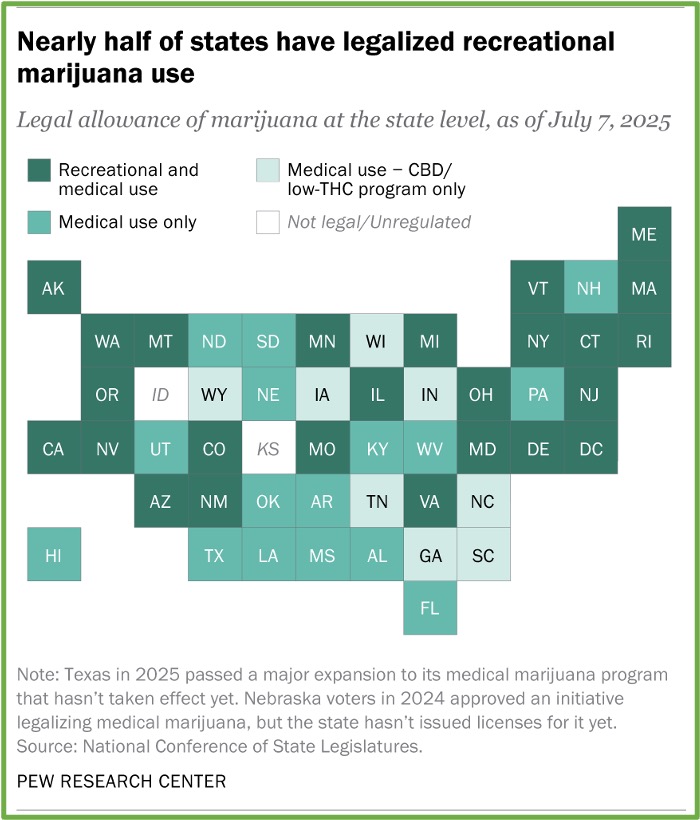
She noted four neighboring states—New York, New Jersey, Ohio and Maryland— have legalized adult recreational marijuana use. This leads to Pennsylvania residents routinely crossing state lines to legally purchase cannabis. This is a valid observation. The Pew Research Center found in 2025 that nearly half of states have legalized recreational marijuana, including most of the states surrounding Pennsylvania, with the exception of West Virginia. See the following graph.
U.S. public opinion on legalizing marijuana has increased dramatically over time, from 12% of Americans in 1969, to 70% of Americans in 2023. But when U.S. adults were able to distinguish between recreational and medicinal legalization, only 54% of U.S. adults thought marijuana should be legal for medical and recreational use, while 33% thought it should be only legal for medical use; and 12% were against any legalization. When given an option, 45% of adult Americans were opposed to legalizing recreational marijuana. There may not be as much support for legislators to approve recreational marijuana as this member of Pittsburgh’s City Council seems to think there is. It seems to depend on how you frame the survey questions.
She then pointed out where President Trump signed an executive order in December of 2025 directing the attorney general to reclassify cannabis as a Schedule III drug under the Controlled Substances Act. This means it would be classified alongside Tylenol with codeine, ketamine and anabolic steroids. Schedule III drugs are seen as less addictive and as carrying legitimate medical uses, unlike Schedule I substances.
The DEA has to review the recommendation to list marijuana as a Schedule III drug under the U.S. Controlled Substances Act and then decide on the reclassification. Even if reclassified, marijuana would still be treated as a controlled substance at the federal level and be subject to tight restrictions and criminal penalties. Obtaining approval to do marijuana research is currently time consuming and expensive because of the rigorous regulatory requirements for research with Schedule I substances.
Senior administrative officials said the primary reason for the executive order was to increase medical research with marijuana and related products to understand their risks and potential for treatment. However, there isn’t consensus on the benefits of rescheduling. Although Medscape said while Democratic Senator Chuck Schumer welcomed the proposed change, dozens of Republican lawmakers condemned the change. They said: “Reclassifying marijuana as a Schedule III drug will send the wrong message to America’s children, enable drug cartels, and make our roads more dangerous.”
Reclassifying marijuana as a Schedule III substance would make it easier to do research into the supposed medical benefits of marijuana, as well as into its risks as a recreational drug. We can hope that reliable and legitimate research with marijuana will bring clarity into the competing claims for its medical uses. It would also enable more research into its public health concerns, such as influence on mental health, teenage substance use, and impaired driving.
But let’s not ignore what may be, perhaps, the most important influence on rescheduling marijuana—its profits potential. USA Facts noted where the first five states to legalize recreational cannabis: Colorado (2012), Washington (2012), Alaska (2015), Oregon (2015), and California (2016) collectively generated $2.78 billion in revenue from taxes on cannabis sales. Cannabis taxes support various initiatives and programs in each state, where the state decides how to use the money based upon its priorities. The revenue potential from cannabis is substantial, according to the Tax Foundation. It projected Nationwide legalization could generate $8.5 billion annually for all states.
Funding is one of the biggest challenges for legal cannabis producers, as current federal restrictions keep most banks and investors out of the business, forcing producers to turn to costly loans or alternative lenders. Analysts said they expected a mandate for cannabis banking would be included in the executive order, but then it wasn’t. Supporters of legalization now incorrectly say a black market thrives because of the high cost of doing business.
Pennsylvanians need to remember that legalizing recreational marijuana has repeatedly benefitted, not harmed, the black market for marijuana. In July of 2019, Politico published “How Legal Marijuana Is Helping the Black Market.” The writer noted how expensive regulation and high demand across the country made the illicit trade more profitable than going legit. The article described black market problems after legalization in California, Oregon, and Massachusetts. Ignoring the fact that the legalization would make marijuana a more viable product for the illegal black market, supporters argued it would eventually lead to stifling it.
Even The Motley Fool weighed in with: “5 Reasons the Marijuana Black Market Won’t Go Away.” In 2019, they said Wall Street stated cannabis was one of the fastest-growing industries on the planet. An estimated fivefold to 18-fold increase in global annual revenue by 2030 was projected. “This type of growth is impossible for Wall Street and investors to ignore, which is a big reason pot stocks have been all the rage.”
Worse yet, the legalization of recreational marijuana in Canada, as well as in select U.S. states, hasn’t stomped out black market cannabis, as initially expected. In California, the largest legal weed market in the world by annual sales, illicit marijuana sales are projected to outpace legal pot sales in 2019 by a significant margin: $8.7 billion to $3.1 billion. Meanwhile, analysts at Scotiabank estimated in early February that the black market would be responsible for 71% of total cannabis sales in Canada in 2019.
Decriminalizing Marijuana
Municipalities across the state have been revising their ordinances to lessen penalties for cannabis offenses since 2014. Philadelphia, Pittsburgh, Harrisburg, State College, Erie, York, Lancaster, Allentown and others have made small amounts of cannabis punishable by a fine. You can look at Wikipedia and NORML for lists of local municipalities. The Prince Law Offices noted where local efforts to decriminalize marijuana in Pennsylvania are in clear conflict with the state’s strict drug laws. They said this disconnection between decriminalization ordinances and state law underscores the tension and legal uncertainty surrounding marijuana regulation in Pennsylvania.
State penalties remain harsh: possession of 30 grams or less of marijuana flower or up to 8 grams of hashish is a misdemeanor, carrying up to 30 days in jail and/or a $500 fine. Possessing larger amounts can bring six to twelve months in jail and fines up to $5,000.
When local ordinances decriminalize marijuana possession, they often clash with Pennsylvania’s Controlled Substance Act (CSA), which generally takes precedence under the principle of state preemption. So, even though cities like Philadelphia and Pittsburgh have reduced penalties for small amounts, stricter state laws still apply. Under the CSA, possessing 30 grams or less of marijuana flower or up to 8 grams of hashish is a misdemeanor punishable by up to 30 days in jail and/or a $500 fine. Many local law enforcement agencies argue that the CSA’s explicit rules on controlled substances leave no room for local governments to alter those penalties.
Decriminalizing Pennsylvania’s marijuana laws and modifying marijuana’s status in the state’s CSA does not have to be linked to legalizing recreational marijuana. State wide legislative action can address these disparities separately from legalization. In 2012, before California legalized recreational marijuana, the state downgraded simple marijuana possession from a misdemeanor to a non-criminal infraction. Statistics showed that marijuana arrests plummeted by 86%, “reversing a two-decade trend of increasing marijuana misdemeanor arrests and returning numbers to levels not seen since before the Summer of Love.”
In summary, 70% of adults supposedly favor legalization. But when medical and recreational marijuana are separated, that dropped to 54%, and with the 12% opposed to any kind of legalization, there are 45% of Americans opposed to legalizing recreational marijuana. While most states surrounding Pennsylvania, except West Virginia, have legalized recreational marijuana, it hasn’t resulted in stifling the black market. Rather, legalization has invigorated it and made it more entrenched. Decriminalization does not have to be linked to legalization of recreational marijuana and will lead to dramatically less marijuana arrests.
Rescheduling could also lead to more to research into the supposed medical benefits of marijuana, as well as its risks as a recreational drug. But by that time the problems with marijuana use are clearly known, the rapid growth of the cannabis industry may make it as difficult to restrict in the U.S. as the tobacco industry was. Being “behind the times” with legalizing recreational marijuana may not be such a bad thing for Pennsylvania. In Part 2, we’ll look more closely at what could the impact be in Pennsylvania if recreational marijuana was legalized.