So, what are spiritual gifts? And have they been extinguished from the life of the church, or do they continue? The first question is more easily demonstrated from Scripture when passages like Romans 12:3-8, 1 Corinthians 12-14, and Ephesian 4:7-13 are referenced. The second question, do spiritual gifts continue or have they ceased, has typically placed discussions of spiritual gifts into either the continuist or cessationist camps. But is there a middle way between approval or rejection of modern spiritual gifts?
The first thing I want to do is alert us to a translation issue with the phrase ‘spiritual gifts.’ The New Dictionary of Biblical Theology said there is no precise Greek equivalent to the English phrase ‘spiritual gifts.’ The Greek phrase, charismata pneumatika, doesn’t appear in the LXX or NT, while there is one use of the singular (pneumatikos charisma) in Romans 1:11. There are other places in English translations where the phrase ‘spiritual gifts’ is used, but in each case as a translation of some other Greek word. In the ESV, it is used in 1 Corinthians 12:1 and 14:1, translating pneumatikos, literally meaning spiritual things. “These initial observations indicate that while ‘spiritual gifts’ is part of the English reader’s conceptual scheme, it may not easily map onto that of the biblical writers.”
Charisma can either refer to a) something freely and graciously given by God as a gift, or b) a special non-material gift from God, as in 1 Corinthians 12:4: “Now there are varieties of gifts (charisma), but the same Spirit.” He urged Timothy to not neglect the gift (charisma) he was given when the council of elders laid hands on him (1 Timothy 4:14). Paul also used the term charisma to refer to eternal life (Romans 6:23), his own celibacy (1 Corinthians 7:7), and Israel’s irrevocable covenant benefits (Romans 11:29). So, charisma is not just a theological term that refers exclusively to the spiritual gifts.
In Perspectives on Pentecost, Richard Gaffin made a distinction between the gift or work of the Spirit (the once-for-all accomplishment of redemption), and the workings or gifts of the Spirit, which are variously distributed within the church. Both of these senses are expressed in 1 Corinthians 12; the gift of the Spirit in verse 12:13, and the gifts of the Spirit are noted in 12:29-30. Richard Gaffin said:
The gift of the Spirit, shared by all believers, is the eschatological essence of the new covenant, the fulfillment of the Father’s promise, the down payment and first fruits of resurrected life. The gifts of the Spirit, while particular expressions of this life, are provisional expressions. Necessitated by, bound up with, and shaped by the conditions that make up “the form of this world [which] is passing away” (1 Cor. 7:31), they are themselves transient (the point of 1 Cor. 13:8-10).
Gaffin said both prophecy and tongues (as xenoglossy) are revelation, bringing God’s Word to the Church. As revelatory “word-gifts,” they ceased once the NT canon was completed. However, he does not believe this means all spiritual gifts have ceased. “The continuation of the large remainder is not in dispute.” And yet, Gaffin is a cessationist. Also see: “Holy Spirit Baptism and Speaking in Tongues.”
He did think some continuationists face a dilemma by implying that Scripture alone is not a sufficient verbal revelation from God; that the canon is at best relatively closed. They seek to put within Church history what belongs to its foundational era. “The balance intended here may be difficult to grasp and maintain, but it is crucial” (Perspectives on Pentecost, p. 46). And yet, a continuist such as Sam Storms wrote: “Why NT Prophecy does NOT result in “Scripture-quality” revelatory words.” Storms said:
Perhaps the most frequently heard objection from cessationists is that acknowledging the validity of revelatory gifts such as prophecy and word of knowledge would necessarily undermine the finality and sufficiency of Holy Scripture. But this argument is based on the false assumption that these gifts provide us with infallible truths equal in authority to the biblical text itself.
Before going down that rabbit hole, let me refer us to the words of Thomas Schreiner, who said:
I am not writing on this topic because I have the final answer on spiritual gifts, for the matter is difficult and Christians who love God and the Bible disagree. Readers should know that Sam Storms and I are friends. We love one another, even though we differ on a secondary or tertiary issue, while at the same time upholding the importance of truth.
Your position on spiritual gifts does not carry the same theological weight as on the Trinity, or the authority and infallibility of Scripture. If you want to explore the two sides of the cessastionist-continuist debate, read “Why I Am a Cessationist” by Thomas Schreiner, and “Why I Am a Continuist” by Sam Storms. There is also Are Miraculous Gifts for Today? Four Views. Wayne Grudem (a continuist) was the general editor; Sam Storms wrote one of the continuist positions, while Richard Gaffin wrote the cessationist position.
A Middle Way Between Approval or Rejection of Modern Spiritual Gifts
I think Vern Poythress proposes a biblically valid middle way between the cessationist and cessationist positions in “Modern Spiritual Gifts as Analogous to Apostolic Gifts: Affirming Extraordinary Works of the Spirit within Cessationist Theology.” As its noted in his title, he makes a distinction between apostolic gifts and modern spiritual gifts. He maintains that “modern spiritual gifts are analogous to but not identical with the divinely authoritative gifts exercised by the apostles.” Apostolic teaching and the biblical canon maintain their exclusive divine authority, so the authority of Scripture is upheld.
The fact that we have analogy rather than identity means that we must respect certain restraints. Modern intuitive phenomena must be subject to the same restraints that are placed on preaching. Everything must be checked for conformity to Scripture.
On the other hand, since there is analogy, modern spiritual gifts are still genuine and useful to the church. Hence, there is a middle way between blanket approval and blanket rejection of modern charismatic gifts.
He then used the three offices of Christ as prophet, priest and king to distinguish the gifts of the Holy Spirit. Poythress said all the gifts mentioned in Romans 12, 1 Corinthians 12 and Ephesians 4 can roughly be classified as prophetic, kingly or priestly. Gifts of wisdom and knowledge are prophetic, while gifts of administration, miraculous powers and healing are kingly gifts. Some gifts can be classified in more than one way, such as healing, which he thought could also be sees as a priestly gift since it is an exercise of mercy towards the person healed. Because the gifts have various functions and intensities, there are several levels of operation for prophetic, kingly and priestly gifts. See the following diagram.
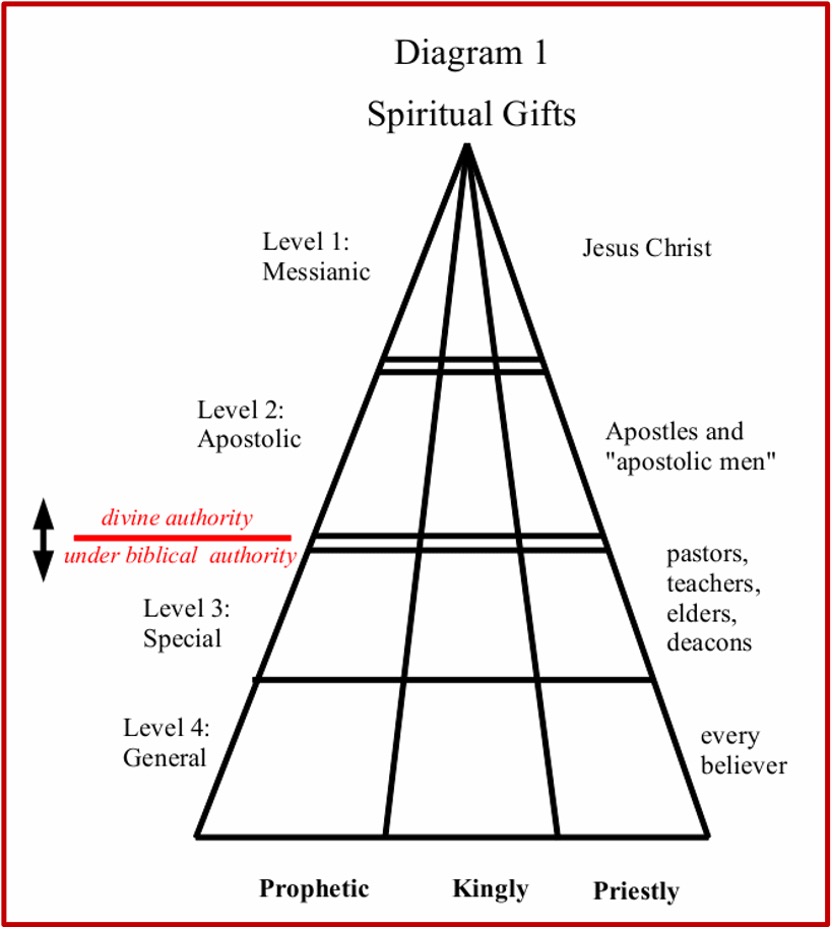
Level 1 is Messianic giftedness and level 2 is apostolic giftedness. Divine, biblical authority exists when spiritual gifts are exercised at these levels and described in Scripture. When spiritual gifts are exercised by those at Levels 3 and 4, they are not divine and are under biblical authority.
The distinction between gifts with full divine authority and subordinate (uninspired) gifts is now clear. Jesus Christ is God (John 1:1; 20:28) and is the Lord of the church (Eph 5:24). His work has full divine authority. The apostles and apostolic men are commissioned by Christ and bear his authority. Hence their words and official actions have divine authority (cf., e.g., 1 Cor 14:37; 1 Thess 2:13). In particular, words of the apostles in the exercise of their office are “inspired” in the technical sense. “Inspired” words are words spoken by God himself, words breathed out by God (2 Tim 3:16), and hence they carry unqualified divine authority.
The Holy Spirit also works in a subordinate way in giving teaching and speaking gifts to pastors, teachers, and ordinary believers (Eph 4:11; Col 4:6). The speeches that these people give are not inspired. That is, the speeches are not identically the speech of God in such a way that they carry unqualified divine authority and perfection.
The Variety of Spiritual Gifts
Scriptural passages that figure most in discussions of the spiritual or charismatic gifts are Romans 12:3-8, 1 Corinthians 12-14, and Ephesian 4:7-13. Got Questions has a slightly different citation of passages on the gifts of the Spirit: Romans 12:6-8, 1 Corinthians 12:4-11, and 1 Corinthians 12:28. The lists in these passages are selective and representative; they aren’t complete. Ephesians 4:14-16 notes the purpose of these gifts: so that we will no longer be children, tossed about by various doctrines. Speaking the truth in love, we are to grow up into Christ. 1 Corinthians 12:7 said each believer is given “the manifestation of the Spirit for the common good.”
If you look at the various gifts described in these passages, there are either nineteen or sixteen of them. Both are more than the listing of the nine so-called charismatic or spiritual gifts in 1 Corinthians 12:8-10: prophecy, tongues, interpretation of tongues, wisdom, knowledge, faith, healing, miracles, and discernment of spirits. This narrow sense of nine spiritual gifts is held by some believers, where they are all wrongly said to be ‘supernatural’ in character.
Gaffin said referring to the gifts and activities in Romans 12, 1 Corinthians 12, and Ephesians 4 as “charismatic” gifts in order to distinguish them from “noncharismatic” gifts and functions, such as service or doing acts of mercy in the church is misleading. Looking at the term charisma, or gift, he noted Paul was the first person to use it as an important theological term. After a brief survey of its use by Paul which we reviewed above, Gaffin said it was a flexible term, used in various ways. Every gift is a manifestation of grace, and any manifestation of grace can be termed a gift or a charisma. “Paul says so in Romans 12:6: ‘We have different gifts, according to the grace given us.’”
The whole church, he said, in all its aspects and activities can be seen as charismatic. Identifying certain gifts as charismatic in order to distinguish them from others runs the risk of distorting or narrowing Paul’s perspective. “Spiritual gifts comprise all the ways in which God by the power of his Spirit uses Christians as instruments in his service.”
The Lexham Bible Dictionary said Paul didn’t think the various gifts in these passages encompass all the possible gifts given by the Spirit. And he doesn’t seem to differentiate between the miraculous and more mundane, indicative of a regular function performed in the Church. Paul’s teaching suggests every member of the church receives at least one gift (1 Cor. 12:7). The gifts are distributed according to the sovereign will of God (1 Cor 12:11; Rom 12:3; Eph 4:7-11). Paul also equates some gifts as a prerequisite for recognized positions in the Church (1 Cor 12:28; 1 Tim 4:14).
Gaffin cautioned his readers to not draw too sharp a line between many of the gifts like “the word of wisdom” and “the word of knowledge”; or “gifts of healing” and “miraculous powers;” or “teaching” and “exhorting.” Nevertheless, he thought the gifts belong in two basic categories: word-gifts and deed-gifts. This distinction is supported by 1 Peter 4:10-11, the only occurrence of charisma outside of Paul’s letters. He thought these verses were a brief, compressed overview of the NT on spiritual gifts:
As each has received a gift, use it to serve one another, as good stewards of God’s varied grace: whoever speaks, as one who speaks oracles of God; whoever serves, as one who serves by the strength that God supplies—in order that in everything God may be glorified through Jesus Christ. To him belong glory and dominion forever and ever. Amen.
There is no magic formula or test that can tell us what our spiritual gifts are. They aren’t limited to or listed in Romans 12:3-8, 1 Corinthians 12-14, and Ephesian 4:7-13. Gaffin thought this was a mechanical approach to the question of spiritual giftedness and unduly restrictive. Further, it seemed to be a product of our contemporary Western mentality and its affinity for the specialist, rather than genuine New Testament spirituality. Instead of asking what is my spiritual specialty or gift that distinguishes me in the church, ask what are the particular opportunities you see for serving other believers (1 Peter 4:10-11).
For a discussion of modern spiritual gifts and prophecy within the New Apostolic Reformation, see: “Believing in Modern Spiritual Gifts” and “The Modern Analogue of ‘Prophecy.‘”