In A New Apostolic Reformation? Doug Geivett and Holly Pivec described how the prevalent teaching in the NAR—New Apostolic Reformation—on the five-fold ministry has been around since the Irvingites of the 1830s. They said the most noteworthy attempt to restore apostles and prophets in North America before the NAR was the short-lived New Latter Rain movement that originated in the late 1940s. There was a revival at a Pentecostal Bible school in North Battleford, Saskatchewan, Canada in 1948 that quickly spread to the United States and then around the world. The Worlds Religions and Spirituality Project said by mid-1949 the New Latter Rain Movement became a major concern for more orthodox Pentecostals and resulted in The General Council of the Assemblies of God USA formally condemning Latter Rain teachings as unbiblical and heretical. By 1952, the Latter Rain as a recognized movement was beginning to fade, “but a number of Latter Rain teachings became major parts of the Charismatic Renewal movement,” including what was known as the five-fold ministry.
In A New Apostolic Reformation? Geivett and Pivec said NAR churches in the U.S. can be found in almost every city and town from Florida to Alaska. They can’t be easily identified by their formal statements of faith, which are typically indistinguishable from those of more traditional churches. “But they often can be identified by their use of the term fivefold ministry, which, as used in NAR, refers to the belief that God has given the church five continuing governmental offices: apostle, prophet, evangelist, pastor, and teacher.”
In addition to NAR churches governed directly by apostles and prophets, a substantial number of churches in Pentecostal denominations, like the Assemblies of God and the International Pentecostal Holiness Church, as well as independent charismatic churches, have been influenced by the so-called apostles and prophets of NAR churches. “Counting all Pentecostal, charismatic, and Neo-Charismatic Christians, the total number of people in the United States who likely have come into significant contact with NAR teachings totals 66 million.”
People from many Pentecostal and independent charismatic churches attend NAR revivals (like the 2008 Lakeland Revival, in Lakeland, Florida, led by the prophet Todd Bentley), buy NAR books (like the bestselling Final Quest, authored by apostle and prophet Rick Joyner), and watch GOD TV (the first NAR television network, broadcast by satellite throughout the world). And what is learned through these and other channels is shared in Sunday school classes and Bible studies. At one independent charismatic megachurch—New Life Church in Colorado Springs, Colorado—NAR teachings are promoted through smaller group studies based on the teaching materials of NAR apostles and prophets like Bill Johnson, Randy Clark, and Doug Addison.
Peter Wagner, a now deceased former professor of church growth at Fuller Theological Seminary, introduced the idea of present-day apostles and prophets to about 500 church leaders in the evangelical academic community when he organized the National Symposium on the Postdenominational Church in May of 1996. Then in 1998 he founded the Wagner Leadership Institute to train leaders for NAR. He claimed traditional seminaries offer a largely theoretical curriculum and have not provided adequate training for ministry. Courses offered by the Institute have included some on apostolic and prophetic ministry, prophetic evangelism, the Seven Mountain Mandate, and the fivefold ministry gifts.
Now headquartered in Pasadena, California, the Institute’s reach extends well beyond the city, with regional training centers and satellite programs in sixteen locations in the United States and international training centers and extensions in Australia, Bolivia, Brazil, Canada, China, Hong Kong, Indonesia, Malaysia, Nicaragua, Rwanda, Singapore, South Korea, and United Kingdom.
“Postdenominational” Churches?
Peter Wagner is widely recognized as a leading authority on present-day apostles, and wrote of his belief that we were living in the midst of what he called the Second Apostolic Age in his book, Apostles Today. He claimed and only obliquely supported that it began around the year 2001. He said the First Apostolic Age lasted for about 200 years “after the first of the New Testament apostles concluded their ministry.” He had not doubt that between these two “apostolic” ages in church history there were apostles present, and then proceeded to name fifteen possible ones.
He thought historically apostles operated “under the radar,” without being noticed, after the first couple of centuries. However, “a growing number of Christian leaders now recognize, acknowledge and affirm both the gift and the office of apostle in today’s churches. The apostles have surfaced!” The emergence of apostles in the postdenominational church corresponded, according to Wagner, with what he called the “New Apostolic Reformation.”
It is a “reformation” because we are currently witnessing the most radical change in the way of “doing church” since the Protestant Reformation. It is “apostolic” because of the gift and office of apostle is the most radical of a whole list of changes from the old wineskin. And it is “new” to distinguish it from several older traditional church groups that have incorporated the term “apostolic” into their official name.
Geivett and Pivec quoted Wagner as saying this radical change in the way of doing church was recognizing “the amount of spiritual authority delegated by the Holy Spirit to individuals” as apostles of the New Apostolic Reformation. Wagner thought the church’s mission depended upon continued apostolic authority. Supposedly, when we submit to the authority of apostles in the government of the church, there will be an outpouring of the Holy Spirit upon our cities, leading to social transformation on a worldwide scale. “In other words, without the authority of today’s apostles, the church cannot fulfill its mission of transforming societies and advancing God’s kingdom.”
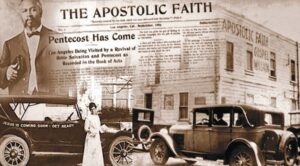
In The Violent Take It by Force, Matthew Taylor suggested many charismatics yearned to be both filled with Holy Spirit power and to be part of something extraordinary. The phenomena known as the Toronto Blessing, beginning in 1994, was a religious experience that seemed to capture the desire of many who wanted to “catch the fire” and receive more of God. It is arguably the best-known North American revival since the Azusa Street Revival, considered to be the birthplace of American Pentecostalism. Well-known NAR leaders such as Bill Johnson, John and Carol Arnott, Randy Clark, Rolland and Heidi Baker, Ché Ahn, Lou Engle and others were at the Toronto Blessing at one time or another. Taylor thought it was no coincidence that Peter Wagner began working on his “postdenominational church theory” that morphed into the NAR at that time.
Charismatic people are ambitious and eager Christians, believers who want revival and fireworks and power, but charismatic associations and denominations are more cautious and institutionally wary of the bedlam that can ensue. The NAR was an idea ready-made for that moment.
Taylor said Wagner wondered whether the churches could be governed by apostles and prophets. “He built upon the foundation of the Latter Rain ideas about the rebirth of the apostolic and prophetic roles (fivefold ministries) that had been kicking around for decades.” Not only was Wagner interested in the idea of new apostles and prophets, he also wanted to find a way “to have it all hang together organizationally.” Peter Wagner was not a scholarly theologian, but a social scientist who dabbled in Christian theology. “So while his NAR ideas have a theological dimension, and Wagner found his rationale [for them] in his interpretation of the Bible, the schema of the NAR is also organizational and pragmatic.”
In Wagner’s mind, if you could just get the apostles and prophets—these supernaturally ordained oligarchs—to work together noncompetitively, they could unite in seeking revival and also take over the whole landscape of churches, and the whole system would be stable and cooperative. Indeed, at a sociological level, that is what all the seemingly obscure and low-profile institutions that Wagner built after he retired from Fuller were about. Wagner was trying to create relationships and power-sharing agreements among the most talented leaders of the Independent Charismatic world so that they wouldn’t fight with each other over which church belonged to whom. Instead, they would work as partners. Wagner was building an ideology and an infrastructure for this charismatic spiritual oligarchy.
Apostles in Today’s Churches
In Apostles Today, Wagner defined an apostle as follows:
An apostle is a Christian leader gifted, taught, commissioned and sent by God with the authority to establish the foundational government of the Church within an assigned sphere of ministry by hearing what the Spirit is saying to the churches and by setting things in order accordingly for the expansion of the Kingdom of God.
Gievett and Pivec concluded this supposed God-given authority “to establish the foundational government of the church,” by “hearing what the Holy Spirit is saying to the churches,” suggested they receive new revelation from God, known as “present truth” or “new truths.” They again quoted Wagner in Apostles Today as saying this new revelation could only be received by apostles and prophets. Apostles can either receive the revelation directly from God, or they can receive it from prophets. Wagner said:
Whereas every believer can and should hear directly from the Holy Spirit, it is only the apostles, in proper relation to prophets, who hear what the Spirit is saying to the churches. Parents hear what the Spirit is saying to their families. CEOs hear what the Spirit is saying to their businesses. Teachers hear what the Spirit is saying to their classes. Pastors hear what the Spirit is saying to their church (singular). But apostles, along with prophets, are those who hear what the Spirit is saying to the churches (plural).
This is not hierarchy, according to Wagner, but it is a divine order, or chain of command: “Apostles are first and prophets are second.” Geivett and Pivec understood Wagner to mean that prophets submit to apostles by providing them with new revelation and then waited for apostles to interpret and implement it. Pastors, evangelists and all others also submitted to their apostles as do the prophets. Astutely, they asked how apostles sitting at the top of church government were kept from abusing their authority. “To whom are they accountable?”
There wasn’t a clear answer to this important question by Wagner or others. A possible kind of accountability lay within the formation of apostolic networks, where groups of apostles voluntarily submitted themselves to the authority of an “overseeing apostle.”
One example of such an apostolic network is Harvest International Ministry (HIM), “an international Apostolic Network dedicated to advancing the Kingdom of God by equipping leaders, multiplying churches, evangelizing, and bringing revival and reformation to the nations.” HIM has more than 25,000 affiliated ministries and organizations in over 65 nations. In The Violent Take It by Force, Matthew Taylor said Ché Ahn and HIM was a perfect case study of how an apostle-to-be went about forging a network of aligned churches and ministries. But the question remains, to whom are these apostles accountable? The following examples of “apostles” David Taylor and Todd Bentley suggest the accountability is spotty.
Holding “Apostles” Accountable
At the end of August 2025, the self-proclaimed apostle and church leader David Taylor of the Kingdom of God Global Church (KOGGC) and his Executive Director were arrested for their alleged roles in a forced labor and money laundering conspiracy that victimized individuals in Michigan, Florida, Texas, and Missouri. According to the indictment, they required victims to work the call centers of the ministry for long hours without pay or perform other services for Taylor. Taylor set unreachable daily, weekly, monthly, and yearly monetary donation goals for individuals working in the call centers, and required them to follow the orders he created without question.
If victims disobeyed an order or failed to reach his monetary goals, Taylor and Brannon punished the victims with public humiliation, additional work, food and shelter restrictions, psychological abuse, forced repentance, sleep deprivation, physical assaults, and threats of divine judgment in the form of sickness, accidents, and eternal damnation.
KOGGC/JMMI received millions of dollars in donations each year through its call centers. Taylor and Brannon used much of the money to purchase luxury properties, luxury vehicles, and sporting equipment such as a boat, jet skis, and ATVs. In total, Taylor received approximately $50 million in donations since 2014.
See “FBI Takes Down Self-Proclaimed Apostle David E. Taylor,” an 18-minute video on the LongforTruth YouTube channel. Daniel Long said: “Now this isn’t just another case of a prosperity preacher buying himself a bigger house or a new car. This is a full-blown federal investigation into forced labor, into human trafficking, into money laundering, and the systemic abuse of men and women who really truly believed that they were serving God.” Long said the most disturbing thing about this whole incident is the way that the victims were treated. Taylor claimed if his people didn’t obey orders, they would suffer in hell: “They were deprived of food and they were deprived of sleep; and they were threatened with hellfire.”
Another apostolic fiasco to consider was with Todd Bentley. Matthew Taylor said he was invited by Stephen Strader, who was a member of Wagner’s apostolic network, the International Coalition of Apostles (ICA), to lead a week-long series of meetings at Strader’s church in Lakeland Florida in April of 2008. He stayed for over four months and led what was called the Lakeland Revival. “The Lakeland revival was marked by evident miracles of faith healing at the hands of Bentley.”
Got Questions said Lakeland focused on spectacle. Bentley claimed the ability to generate oil from his palms and produce gold dust from his pores. Reminiscent of Smith Wigglesworth, in the name of “healing,” he kicked a woman in the face, slammed a crippled woman’s legs against the stage and knocked out a man’s tooth. Strader asked the ICA where the apostles were. “This is day sixty of the Outpouring and I have not heard from the apostles.” Some ICA members were hesitant because of firsthand reports of Bentley’s pattern of ungodly and immoral behavior over 20 years, including reports of sexual abuse. This ultimately led to a panel of charismatic church leaders saying Bentley was disqualified from ministry in 2020 for his behavior.
But there was more to the story of Bentley’s eventual disqualification. Peter Wagner hoped Lakeland would be the early stages of a global revival, but was also aware of Bentley’s instability, according to Taylor. So, he decided on a two-step process. A group of leading apostles would gather in Lakeland at the end of June 2008 for a public commissioning and alignment ceremony of Bentley as an apostle. Then a group of apostles led by Ché Ahn would meet privately with Bentley to help him “clean up his act” and hold him accountable.
In July of 2008, ABC’s Nightline aired an expose on Bentley’s criminal history and questionable revival practices. ABC’s reporters could not independently confirm even one case of healing, despite Bentley’s promises that he could provide documentation. Then “it came out that Bentley had been drinking during the revival, and he was divorcing his wife because he had fallen in love with their nanny.” Matthew Taylor said:
The Lakeland debacle cast a pall over Wagner’s impending retirement, and it raised searching questions about his whole NAR paradigm. If Wagner and others had concerns about Bentley all along, why did they make their endorsement ceremony so public? If so many prophets were hearing straight from God, how come none of them heard from God about Bentley’s secret vices?
According to NAR theology, apostles get their authority directly from God. It is a “spiritual gift,” a gift of unearned grace. But the office of apostle in the NAR must be earned. Apostles have to demonstrate extraordinary character that is marked by holiness and humility. Even by NAR standards for the office, David Taylor and Todd Bentley didn’t demonstrate those character traits and weren’t true apostles.
Nevertheless, Peter Wagner believes God started to open doors when some churches began to recognize the office of apostle after the Latter Rain revival of the late 1940s. We will examine in more detail how this so-called revival movement eventually led to the NAR and how Peter Wagner helped organize and biblically justify this new way of doing church within the NAR in Part 2 of this article. For more on Edward Irving and the Irvingites, see “No One Knows” and “In Spite of Delusions.”