Born in July of 356 BC, Alexander the Great, became king of Macedon when he was 20. By the time he was 30, he ruled over one of the largest empires in history, stretching from Greece to northwestern India. Undefeated in battle, he is widely considered to be one of history’s greatest and most successful military commanders. He died at the age of 33 in Babylon, which he had planned to make the capital of his empire. There are disputed versions of his untimely death, one of which suggested he died from “the classic symptoms of acute alcoholism.”
In 1980, The New York Times persuasively described a series of behaviors that indicated Alexander was in a “special group of alcoholics” called cyclothymic drinkers. This refers to an individual who uses alcohol to self-medicate the emotional highs and lows of what we now call bipolar disorder. Although experts thought this hypothesis was “pretty convincing,” they didn’t think Alexander could be considered an alcoholic in the modern sense of the term. “Whether or not it can be fully proved is doubtful.” Nevertheless, I think we can say Alexander was clearly a problem drinker.
The Macedonians of his time were notorious for their drinking. While the Greeks drank their wine with water, Macedonians drank theirs undiluted and often. “Drinking prowess was a measure of manliness.” His father, King Philip, was known for his intemperance. The Antigone Journal said the orator Demosthenes remarked to Philip that “heavy drinking is an excellent quality in a sponge but not a king.”
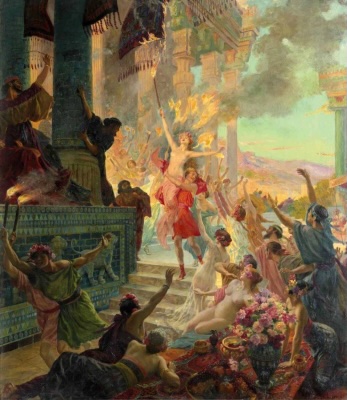
His mother, Olympias, was a devotee of the cult of Dionysus, “the god of wine who was worshiped in orgies of intoxication.” Olympias persistently urged Alexander to out do his father, which he appeared to do militarily and with drinking. In 330 BC, with a torch in hand, a drunken Alexander led revelers in a procession to honor Dionysus that ended by burning down Persepolis (the capital of the Persian empire), an action he bitterly regretted when he sobered up. Two years later in a drunken argument, Alexander killed Cleitus, a friend who had once saved his life. “Alexander pulled the spear from the victim’s body and tried to impale himself, but his bodyguards intervened.”
Ancient accounts are full of stories of Alexander’s immoderate drinking, saying he was “too fond of wine” or that he “slept through the next day from drinking.” Both ancient and modern chroniclers were reluctant to say he was alcoholic or ascribe his behaviors like those noted above to alcohol. Some said the stories of his excessive drinking to were fabrications of Alexander’s enemies. These scholars were reluctant to believe “that the conqueror of the ancient world could be a drunkard.”
Alexander’s drinking grew more compulsive following the death of his most trusted commander, Hephaestion, in 324 B.C. They had been friends from youth and, by most accounts, were lovers. Hephaestion also drank excessively. After successive drinking bouts, he came down with a fever and died after drinking a half-gallon of wine at breakfast. A distraught Alexander had the physician crucified for negligence. The final year of Alexander’s life was punctuated with massacres, bloody purges and drunken binges.
The Antigone Journal said an anti-Alexandrian historian named Niobule reported Alexander brought on his own death at 33 (323 BC) by drinking a separate toast to each of his twenty dinner guests one by one, and then finishing off a twelve-pint pitcher of undiluted wine. But Alexander wasn’t the only ancient person to be known to have a drinking problem or problem behavior as a result of drinking. From the earliest times of culture and civilization, humans have pursued intoxication.
Why Do We Get Drunk?
The first mention of drunken behavior in the Bible is when Noah became intoxicated after he had planted a vineyard. He gets naked, passes out, and was seen by one of his sons, Ham (Genesis 9:20-22). But there is an interesting “encounter” described within a 9th century Midrash, Midrash Tanhuma, between Noah and Satan. As the story is told in the Midrash, Satan approached Noah while he was breaking ground for a vineyard to make wine, which “gladdens the heart of man.” Noah agreed to partner with Satan in the business of planting a vineyard.
Satan thereupon slaughtered a lamb and then in succession a lion, a pig and monkey, and fertilized the soil with each in turn. Thus Satan conveyed to Noah the qualities of wine. If a man drinks one glass, he is as meek as a lamb; if he drinks two glasses, he is boastful and feels as strong as a lion; if he drinks three or four glasses, then behaves like a monkey, he dances around, sings, talks obscenely and does not know what he is doing; and if he becomes intoxicated, he resembles the pig.
While I don’t think this Midrash expounds the hidden wisdom of Genesis 9, it does describe the progressive influence of drinking alcohol upon the individual and helps to understand the behavior of both Alexander the Great and Noah when they drank wine. But I think Proverbs 23:29-35 is a better description of out-of-control drinking and the consequences it brings to the one who is imbibing. In his essay, “Why Do Men Stupefy Themselves?” Leo Tolstoy is also helpful. He said it is our need to hide ourselves from the demands of conscience:
For man is a spiritual as well as an animal being. He may be moved by things that influence his spiritual nature, or by things that influence his animal nature, as a clock may be moved by its hands or by its main wheel. And just as it is best to regulate the movement of a clock by means of its inner mechanism, so a man—oneself or another—is best regulated by means of his consciousness. And as with a clock one has to take special care of that part by means of which one can best move the inner mechanism, so with a man one must take special care of the cleanness and clearness of consciousness which is the thing that best moves the whole man.
Commenting on Isaiah 28:7, The IVP Bible background commentary: Old Testament said brewing beer and fermenting wine was known in Mesopotamia and Egypt from protoliterate times (4,000 BC). Banqueting scenes were common in Assyrian art. “A Sumerian hymn to the goddess Ninkasi celebrates the brewing process and gives thanks for the beverage that slakes the thirst and gushes forth in abundance like the Tigris and Euphrates.” There is evidence in the Mari texts that intoxication was viewed as a favorable condition for receiving divine oracles. Further negative consequences of drunkenness are described in Psalm 69:12, Proverbs 20:1, and in the drunken parties portrayed in Esther 1:3-8 and Daniel 5:1-4.
The Drunk Hypothesis
Fermenting intoxicating beverages parallels the transition of humans from hunter-gatherers to farmers, and eventually to cities and civilization. There is even a theory called the “drunk hypothesis” that suggests alcohol helped establish societies. A study published in Humanities and Social Sciences Communications, “Did alcohol facilitate the evolution of complex societies?” argued that drinking alcohol facilitated the rise of complex societies by promoting social bonding, increasing cooperation, and enhancing creativity.
Our results support the idea that the group-level social benefits of traditional non-distilled fermented beverages may outweigh their disruptive effects, and that alcohol may have facilitated the evolution of human societies. However, other contributing factors, such as agriculture or religion, were probably more effective drivers than getting drunk.
Alcoholic beverages are not just ordinary food consumed only for sustenance. They are valuable primarily for their intoxicating and affective power, their ability to transform and manipulate people, places, and events. For this reason, many early states deeply invested in the production, distribution, and consumption of beer and wine. The ability to control such highly valued foodstuffs allowed the local leaders to confer power and influence over others. Through the public provision of alcohol, whether by production or trade, elites maintained the allegiance of their followers, acquired social prestige, and reinforced their political authority. In addition, large-scale alcohol-driven feasting helped to expand social networks and facilitate interregional interaction and cooperation. In small-scale non-monetary societies, alcohol also played a significant role in mobilizing labour beyond the level of a basic production unit.
In “The Drunk Hypothesis Claims Ancient Societies Were Built with Alcohol,” Discover Magazine said the study’s researchers found a positive relationship between fermented beverages and higher levels of political complexity. In most cases, alcohol was a by-product of agriculture, rather than the cause of it. Alcohol became embedded in society in many ways. It was an important part of feasts and helped expand social cohesion for the lower classes. Leaders “used it to build alliances, acquire social prestige and motivate workers.”
For more information on the ancient cultural and biblical understanding of alcohol and drunkenness, see “There Is Nothing New Under the Sun” and “It Bites Like a Serpent.”
Photo credit: The burning of Persepolis from Antigone.