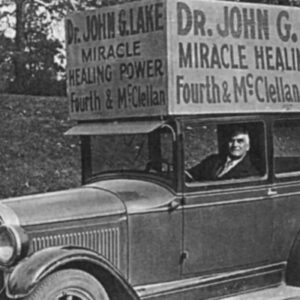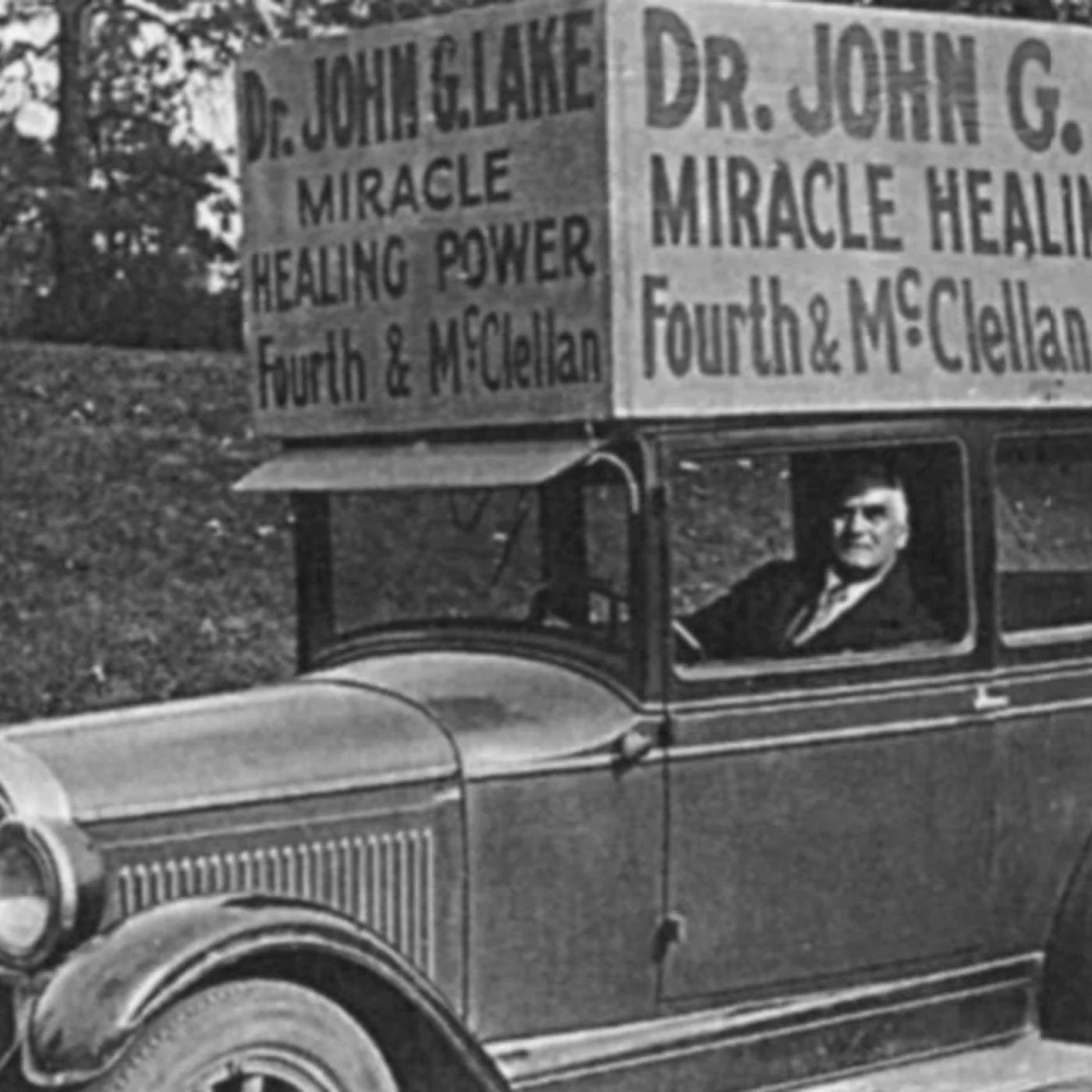
Depending upon who you turn to, John G. Lake was either a con man, or someone whose insights into the Spirit-filled life were 100 years ahead of his time. Bill Johnson of Bethel Church in Redding California thought Lake was one of the greatest heroes of the faith that ever lived. He said in Defining Moments: “In some ways John G. Lake has had more of an impact on my life than any other historical figure. His understanding of the kingdom of God and the life of dominion over the powers of darkness is unparalleled.” In When Heaven Invades Earth, Johnson credited Lake’s sermon, Triune Salvation for his personal understanding of how the gospel touches the whole person: “The gospel of salvation is to touch the whole man: spirit, soul, and body. John G. Lake called this a Triune Salvation.”
Lake gave the sermon in London England during the winter of 1913. His text was 1 Thessalonians 5:23-24, where Paul said: “Now may the God of peace himself sanctify you completely, and may your whole spirit, soul, and body be kept blameless at the coming of our Lord Jesus Christ.” But Lake did not exegete the text. He seemed to presume that human nature was self-evidently triune—spirit, soul, and body.
In Triune Salvation, Lake said: “Man is triune – body and soul and spirit. – just the same as God is triune, being Father and Son and Holy Ghost.” He thought salvation began at the time the spirit was surrendered to God and when we received conscious knowledge of sins being forgiven. “Then God witnesses to the spirit that our sins are blotted out.” Lake said the real Christian was a separated man. “He is separated forever unto God in all the departments of his life, and so his body and his soul and his spirit are forever committed to God.” This absolute consecration to God, “this triune salvation,” was supposedly the real secret of a successful Christian life. Further on in his sermon when referring to human nature he said: “Nature has three departments, and therefore the surrender of the spirit to God is not all that He demands. God demands also the mind and the body.”
But Paul was referring here to the wholeness of the person, not their tripartite nature of body, soul, and spirit. In his commentary on 1, 2 Thessalonians, Michael Martin said: “Paul was not describing the human person as a three-part conglomerate but as a being with material and nonmaterial existence who may or may not be spiritually enlivened in relation to God.” The footnote for 1 Thessalonians 5:23 in The Reformation Study Bible said the phrase “your whole spirit and soul and body” emphasized the wholeness of the perfection:
“Spirit” and “soul” are used as virtual synonyms in the Bible for the spiritual component of a person. When the terms occur together (as here and in Heb 4:12), it is difficult to find any significant difference in meaning.
Not all Christians would agree with this interpretation of the verse. For example, H.D.M. Spence in his commentary on 1 Thessalonians said 5:23 was “a distinct statement of the three components of human nature.” The concern is not bipartite versus tripartite, but how Lake applied the tripartite view. He said after giving their hearts to God, after receiving the witness of the spirit, people wondered why they were troubled by evil desires and tempted in evil ways. Since our nature has three departments, surrendering the spirit to God is not all He demands. “God demands also the mind and the body.” Lake believed humans can be committed to God with their spirit, while at the same time trusting their soul and bodies to man.
When one trusts any department of his being to man, he is weak in that respect, and that part of his being is not committed to God. When we trust our minds (soul) and our bodies to man, two parts are out of the hands of God, and there remains only our spirits in tune with heaven. It ought not to be so. The committing of the whole being to the will of God is the mind of God.
Lake alluded to Genesis 2:7 without explicitly citing the verse, which in the ESV says: “Then the Lord formed man of dust from the ground and breathed into his nostrils the breath of life, and the man became a living creature.” Following the KJV, Lake said God breathed into Adam the breath of life, “and man became a living soul.” As we’ve discussed elsewhere in “Developing a Tripartate Understanding of Human Nature,” translating the word nep̄eš as “soul” here suggests the influence of Hellenistic thought, and/or the use of the Greek word psyche (soul) in the Septuagint translation of Genesis 2:7.
In Created in God’s Image, Anthony Hoekema said the biblical use of soul, spirit and heart typically refer to the whole person. Whether in the Old or New Testament, soul and spirit are often used interchangeably. Heart also described the whole person in both the Old and New Testaments. “The human person must be understood as an embodied soul or a ‘besouled’ body. He or she must be seen in his or her totality, not as a composite of different ‘parts.’ This is the clear teaching of both the Old and New Testaments.”
Lake and Little Gods Theology
Lake’s division of human nature into three “departments” of body, soul, and spirit can be seen to underlie the theology of the NAR and Word of Faith. Referring to God’s creation of Adam, Lake said God breathed into Adam His own self, his own being. “He injected, or breathed, Himself into the man, and the man then became a composition of that heavenly substance … and earth.” Adam was the created Son of God, according to Lake.
Man being composed of God, of heaven, of a heavenly materiality, and his body of the earth, being a sovereign like God, being on an equality with God in sinlessness, God treating him on an equality and giving him dominion over the earth, man as a reigning sovereign on the earth. Everything, all conditions, spiritual and physical, were subject to that God-man.
This idea that God injected or breathed himself into man aligns with the Mormon heresy that people can become gods in their own right. It also is the foundation for the ‘little god controversy’ that originated in Word of Faith teaching. In “’Little Gods’ Theology in Kris Vallotton and Kenneth Copeland,” Kenneth Copeland said: “You’re not a little like him [Jesus], you are exactly like Him. . . you were born exactly with the same spiritual DNA as Jesus.” Kris Vallotton said: “When you look at Jesus, it’s like looking in a mirror. He’s your twin brother.”
In “Are Christians ‘little gods’?” Got Questions said the controversy is understanding that created in the image of God (Genesis 1:27) means humans are actually divine; in the same “spiritual class” as God Himself. “Biblical theologians decry this concept as misguided at best, and heretical and cultic at worst.” If the ‘little gods’ belief is accepted, it imputes to Jesus a lesser divinity; “He became a ‘little god’ like us.”
Lake and Divine Healing
Lake said divine healing was the removal of disease by the power of God, but divine health was to live day by day and hour by hour in touch with God, “so that the life of God flows into the body, just as the life of God flows into the mind or flows into the spirit.” Note the implicit division here between body, and mind and spirit from the life of God. The Christian or child of God as the Christ-man who commits himself to God should not be a subject for healing, according to Lake, because he has continuous, abiding health. “And the secret of life in communion with God, the Spirit of God, is received into the being, into the soul, into the spirit.”
Just as God supplies health to the spirit and health to the soul, he trusts God to supply health to his body. Divine healing is the removal by the power of God of the disease that has come upon the body, but divine health is to live day by day and hour by hour in touch with God so that the life of God flows into the body, just as the life of God flows into the mind or flows into the spirit.
In his sermon “Triune Healing,” Bill Johnson said “Healing was to be offered in the same redemptive brush as was the forgiveness of sins. . . The word salvation actually points to the forgiveness of sin, the healing of disease, and the deliverance from torment.” He then said in Romans 14:17, Paul taught us something about the kingdom of God: “For the kingdom of God is not a matter of eating and drinking but of righteousness and peace and joy in the Holy Spirit.” Johnson said righteousness was God’s answer to the sin problem, peace was God’s answer to the torment problem, and joy was His answer to the sickness problem. “So, the kingdom represents a triune healing for the whole person; spirt, soul, and body.”
Lake said salvation was a redemption of the whole man from all the power of sin, “sin in the spirit, sin in the soul, sin in the body.” If salvation or redemption was from the power of sin, “then the effects that sin produces in us must disappear and leave when the source is healed. Thus, instead of remaining sick, the Christian who commits his body to God becomes at once, through faith, the recipient of the life of God in his body.” This belief was behind Bill Johnson’s and John Lindell’s persistent affirmation that a woman with three amputated toes miraculously had them grow back during the “Week of Power” at James River Church in March of 2023.
For more information on John G. Lake, see “John G. Lake: A Wolf in Sheep’s Clothing.”
A Systematic Theology for the NAR
There is even a systematic theology written for the NAR that bases its system of thought on a triune, tripartite view of human nature. Harold Eberle wrote Systematic Theology for the New Apostolic Reformation: An Exposition in Father-Son Theology. This was the title given to the second edition of Father-Son Theology, published in 2016. The second edition title suggests this is the go-to book on systematic theology for the NAR. Eberle explicitly said so in the Preface:
This work is written for the consideration of leaders with whom I fellowship. In particular, for those within the New Apostolic Reformation which is a current worldwide move of God in which leaders believe the orthodox Christian doctrines laid out in the Apostles’ Creed, but also that the ministries of apostle and prophet are valid ministries in the modern Church. This movement is also known for its belief in the gifts of the Holy Spirit, including tongues, prophecy, and divine healing, as valid works of God today.
In Volume IV Section J, “The Triune Nature,” Eberle said he would examine human nature from the biblical trichotomous view of a spirit, soul, and body. He rejected the dichotomous view of human nature (as body and soul), believing it to be dominated by Platonic thought, which he said became syncretized with early Christianity.
Just as the dichotomous view corresponds with Plato’s dualistic cosmology, the trichotomous view corresponds with the biblical cosmology. With the biblical cosmology, we can see that Adam’s body existed in the natural realm. Adam’s spirit originated with the breath that came from God.
Eberle interpreted 1 Thessalonians 5:23 and Genesis 2:7 as supporting his trichotomous view of human nature. Above we discussed an alternative understanding for 1 Thessalonians 5:23, namely that Paul was referring to the whole person, not their tripartite nature with body, soul, and spirit. In a similar way I’d suggest Eberle wrongly interpreted Genesis 2:7 as supporting trichotomy. He said:
In this verse [Genesis 2:7], the Hebrew word for “breath” is ruach, which can also be translated as “spirit.” Recognizing this, we can identify three parts to Adam’s being: spirit, soul, and body. The spirit came from God, the body was formed from the earth. And the soul was the created element that came into existence when the spirit of God had contact with the physical body.
This statement seems to follow how 19th century trichotomists like John Bickford Heard understood Genesis 2:7. The point to remember for both verses is the author of Genesis and Paul were discussing humans in their unity, not in their departments or distinct parts. See “Developing a Tripartate Understanding of Human Nature” for a discussion of 19th century trichotomy and seeing Adam as a created, whole person in Genesis 2:7.
One Person with Two Sides
Got Questions noted in “Trichotomy vs. dichotomy of man—which view is correct?” that the Bible does teach humanity possesses a physical body, a soul, and a spirit. But there are four primary theories, not just the two identified by Eberle. Dichotomy and trichotomy center on the distinction of human soul and human spirit, whereas anthropological monism and anthropological hylomorphism, describe how the three aspects of humanity (body, soul, and spirit) combine to form human nature.
Those who believe that human nature is a trichotomy typically believe the following: the physical body is what connects us with the physical world around us, the soul is the essence of our being, and the spirit is what connects us with God. This is why the unsaved can be said to be spiritually dead (Ephesians 2:1; Colossians 2:13), while they are very much physically and “soulishly” alive. Those who believe that human nature is a dichotomy would have the same understanding of the body but would view the spirit as the part of the soul that connects with God. So, the question of dichotomy vs. trichotomy is essentially whether the soul and spirit are different aspects of the immaterial human nature, or if the spirit is simply a part of the soul, with the soul being the whole immaterial part of the human nature.
Both theories, according to Got Questions, are biblically possible. So, don’t be as dogmatic as Eberle and Lake were, or you may wander into error or heresy. This seems to be an issue we cannot fully grasp with our finite minds. God did not choose to make clear in His Word which view of human nature was correct.
Anthony Hoekema said it’s not possible to construct an exact biblical psychology since the Bible uses terms like soul, spirit and heart “more or less interchangeably.” He rejected both dichotomy and trichotomy calling for what he described as a “psychosomatic unity” of human beings. Biblically, human beings are one person with two sides: physical and nonphysical. “The advantage of this expression is that it does full justice to the two sides of man, while stressing man’s unity.” For a more detailed discussion of Hoekema’s thoughts on the psychosomatic unity of human beings, see “Created in the Image of God?, Part 2.”