The Bible clearly teaches there would be a unique bestowal of the Holy Spirit upon the New Testament church. Joel’s prophecy (Joel 2:28-29) was quoted by Peter in his address (Acts 2:16-21). Joel prophesied the Spirit would be poured out on all flesh, and that is what happened on the Day of Pentecost. Jesus Christ also predicted the Spirit would be poured out on the church after He returned to the Father (John 16:7; Acts 1:8). The Holy Spirit was to dwell in the church as His temple and take up permanent residence in every member of the church. In Holy Spirit Baptism, Anthony Hoekema said: “This outpouring of the Spirit on Pentecost Day, therefore, was a historical event of the greatest importance—unique, unrepeatable, once-for-all.”
In Perspectives on Pentecost (p.22), Richard Gaffin said the same: “Pentecost is to be understood first of all as part of the once-for-all accomplishment of redemption (historia salutus) rather than as a part of its ongoing, continual application (ordo salutus).” Although these two expressions are intimately related, they must not be confused. “To do so necessarily jeopardizes the absolute sufficiency and finality of Christ’s work.” All believers share in the gift of the Spirit (Ephesians 1:13) from the time of their incorporation into the body of Christ.
The events in Acts 8:14ff (Simon the magician at Samaria), 10:44ff (Cornelius and those at his house at Caesarea), and 19:1ff (Paul at Ephesus after Apollos had preached) are used to challenge this conclusion. But remember what Jesus said to his disciples in Acts 1:8 just before he ascended: ‘But you will receive power when the Holy Spirit has come upon you, and you will be my witnesses in Jerusalem and in all Judea and Samaria, and to the end of the earth.” The narrative in Acts conforms broadly to what Jesus said here. Caesarea and the town of Samaria were both within the Roman province of Samaria, which was located between Galilee and Judea. Gaffin said: “Luke is concerned to show that subsequent developments transpired as Jesus said they would.”
If we accept Pentecost as a once-for-all event, then the disciples speaking in tongues was also part of the once-for-all-event. They were speaking in the native languages of the Jews who came from other parts of the Roman empire to Jerusalem to celebrate the Passover. Evidence in support of this is in Acts 1:5, where Jesus said the disciples would be baptized with the Holy Spirit “not many days from now.” Peter’s citation of Joel’s prophecy suggested he thought what the Jews were hearing was the fulfillment of the words of Joel.
This is reinforced by Peter’s response when he was sent by God to Cornelius, shared the gospel and the Holy Spirit fell on those who heard and they spoke in tongues (Acts 10:1-11:18). When Peter testified of the event before the other apostles and brothers at Jerusalem, he said the Holy Spirit fell on them “just as on us at the beginning” (Acts 11:15). Nowhere in the Epistles is there a repetition of this special baptism of the Spirit. The ISBE, International Standard Bible Encyclopedia said:
The baptism of the Spirit as thus bestowed was, however, the definite gift of the Spirit in His fulness for every form of spiritual blessing through the divinely ordained ministry of word and sacrament. All subsequent NT writings assume this presence of the Spirit and His availability for all believers. The various commands and exhortations of the Epistles are based on the assumption that the baptism of the Spirit has already taken place, and that, according to the prediction of Jesus to the disciples, the Spirit is to be with them forever (Jn. 14:16). We should not therefore confuse other forms of expression found in the NT with the baptism of the Holy Spirit.
Speaking in tongues, known as glossolalia, is where people utter words or speech-like sounds, thought to be languages unknown to the speaker. Sometimes a distinction is made between glossolalia and xenoglossy, belief that the language being spoken is a natural language previously unknown to the speaker. I’d suggest speaking in tongues or “glossolalia” is different from the Pentecostal gift of speaking real languages. So, it’s not necessarily coming from a cessationist position on all supernatural gifts, to assert baptism in the Spirit and speaking in tongues were part of a once-for-all event at Pentecost. Gaffin said this was “a belief that glossolalists have misunderstood Scripture and wrongly attributed to the Holy Spirit something that may be explained naturalistically.”
Also see this 15 minute video, “Biblical Greek Refutes Modern Glossolalia.”
History and Tongues
There is evidence of a belief in the baptism or infilling of the Spirit and speaking in tongues throughout Church history. But here we will focus on the last 400 years. The Society of Friends or Quakers were founded by George Fox (1624-1690) in England. Their central doctrine was the “inner light” or “inner word,” where the Holy Spirit spoke directly to the human mind. In worship, Quakers would sit in silence and wait for God to speak through one or more of them, likening their experiences to Pentecost. In Initial Evidence, Stanley Burgess said of the Quakers: “There is even evidence of tongues-speech among them, although Fox eventually discouraged such ecstatic utterances.”
A sect of the Camisards known as the “French Prophets” believed they were “possessed” or divinely inspired by the Holy Spirit. They believed God had not restricted Himself from “dispensing again the extraordinary Gifts of His Spirit unto Men.” They believed Joel’s prophecy would have a greater fulfillment in their time than in the early church. They would be reportedly seized by ecstatic inspiration, and would strike themselves, falling on their backs and shutting their eyes. “After remaining in trances, they came out with twitches, uttering strange and often amazing things. Sometimes they spoke in human languages of which they had no knowledge, but more frequently in unknown tongues.”
The modern Pentecostal belief of glossolalia as the initial evidence of Spirit baptism was a completely novel idea until the time of the nineteenth century Irvingites. Edward Irving’s (1792-1834) interest in prophecy and millenarianism led him to the belief that there would be a restoration of spiritual gifts to the church before the return of Christ. He toured Scotland preaching this message. Early in 1830 near Glasgow, Mary Campbell, a follower of Irving, prayed and believed she received the gift of tongues. She thought she was speaking the language of the Pelew Islanders of the South Pacific and that she was called there as a missionary.
Mary and her husband left England, intending to become missionaries in the South Pacific. But they returned to England when they recognized “her gift of tongues did not enable her to speak any of the languages they came upon.” For more information on Edward Irving, see “In Spite of Delusions” and “No One Knows.”
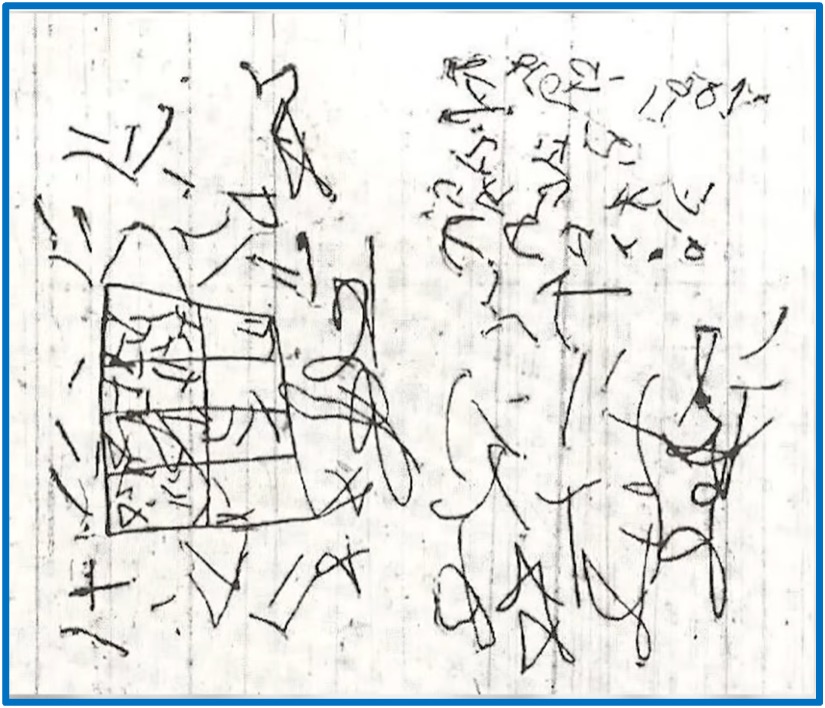
Modern Pentecostalism is typically said to have originated when Agnes Ozman began to “speak in tongues” on January 1, 1901 at Bethel Bible College in Topeka Kansas. Charles Parham and his students thought this gift consisted of real human languages. They believed she was speaking Chinese. For the rest of the day, she seemed unable to speak in English. She also wrote with a stylized scribbling that Parham and others judged to be Chinese. Below is a copy of her supposed Chinese writings:
Parham said in the Topeka State Journal on January 7, 1901: “The Lord will give us the power of speech to talk to the people of the various nations without having to study them in schools.” And in the Kansas City Times on January 27, 1901, he said: “A part of our labor will be to teach the church the uselessness of spending years of time preparing missionaries for work in foreign lands when all they have to do is ask God for power.” Here is a short video by Daniel Long on YouTube that documents although they thought they could go to the mission’s field without any language training, “They did, and they came back humiliated.” Parham’s Embarrassed Missionaries.
The origins of the charismatic movement or Neo-Pentecostalism began on April 3, 1960 when Dennis Bennett resigned as rector of St. Mark’s Episcopal church in Van Nuys, CA, because of dissension in the congregation where he had begun to speak in tongues. Modern Pentecostals and charismatics now believe tongues is a heavenly or spiritual language, a belief that emerged when early Pentecostals had to acknowledge their original understanding of the gift of tongues did not consist of human languages. Yet, modern charismatics do acknowledge the possibility that tongues can sometimes be foreign languages. D. A. Carson observed in Showing the Spirit, “Modern tongues are lexically uncommunicative and the few instances of reported modern xenoglossia [speaking foreign languages] are so poorly attested that no weight can be laid on them.”
In our time speaking in tongues is often associated with a belief in and pursuit of a second experience of the outpouring of the Spirit. This belief in Spirit-baptism is that it is a distinct experience from conversion where the person receives the Spirit into their life, empowering them for witness and service. It’s yearned for in contemporary Christian music. “Send The Fire” is a song by Jesus Culture that says: “We need another Pentecost (Send the fire).”
Richard Gaffin said if you take away this doctrine, the second blessing of the Spirit, you no longer have foundational support for Neo-Pentecostalism. Not only will your belief in or desire for Spirit-baptism influence how you interpret Acts 2, it will also influence how you understand 1 Corinthians 12-14 and the other Scriptures on the “spiritual” gifts.