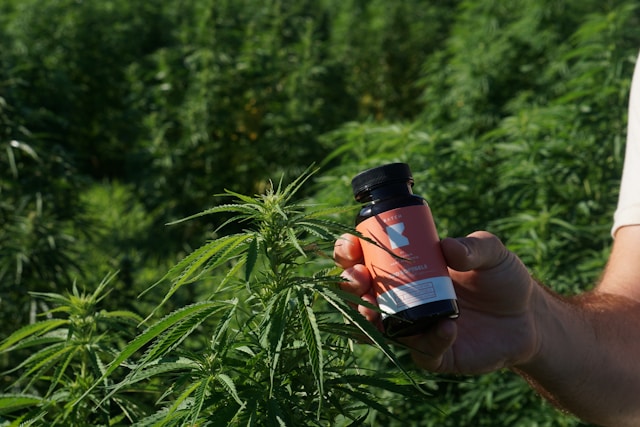
Cannabis and its derivatives, such as hemp, are considered marijuana, which is a Schedule I controlled substance according to the Controlled Substances Act. This meant that hemp was viewed as an illegal substance until Congress passed the 2018 Farm Bill, which distinguished between cannabis as marijuana and cannabis as hemp. The 2018 Farm Bill defined hemp as: “any part of the cannabis plant or its derivatives containing no more than 0.3% delta-9 tetrahydrocannabinol (delta-9 THC) on a dry-weight basis.” This opened a loophole through which the hemp industry was able to produce legally unregulated cannabis products anywhere in the U.S. with enough THC to get you high. It became a $30 billion dollar industry, according to the Cannabis Farmers Alliance.
This was an unintended consequence—unintended that is by Senator Mitch McConnel, who helped craft the 2018 Farm Bill and lobbied for it to be approved. The Hill said the absence of federal rules and regulation with hemp allowed cannabis products to be sold without strong labeling or testing requirements. “Hemp companies began synthesizing high levels of delta-8 THC from CBD derived from hemp, and selling it in stores and online.” The market was flooded with hemp-derived gummies, drinks like THC-infused seltzer, and vapes that can give people a marijuana-like high.
PBS and other new outlets noted that Senator McConnel recently helped to close that loophole, saying industrial hemp and CBD would remain legal for industrial applications. He said: “It will keep these dangerous products out of the hands of children, while preserving the hemp industry for farmers.” Senator McConnel thought companies exploited the Farm Bill loophole to legally formulate products with enough THC to get people high and get around the fact that marijuana was still an illegal substance at the federal level.
The Washington Post quoted McConnel as saying: “Unfortunately, companies … [take] legal amounts of THC from hemp and [turn] it into intoxicating substances. . . These companies then market it to children in ‘candy-like packaging’ and sell it in ‘easily accessible places like gas stations.’” The Hill said the new law stops companies from selling unregulated marijuana products masquerading as hemp. But the provision could threaten the hemp industry’s future, even though it doesn’t take effect until November 2026.
Hemp contains lower levels of THC than its cousin marijuana and must contain 0.3 percent or less by dry weight of THC to be legally classified as hemp. But this creates a loophole: Producers can buy legal hemp and extract the THC to create higher concentrations that can then be added to food or beverages, making products with THC levels similar to those sold in legal marijuana stores. The products include hemp drinks, which have exploded in popularity alongside vapes and gummies.
McConnell and most Republicans in the Senate approved the restrictions, which would keep the 0.3 percent limit on hemp-derived cannabinoid products for human or animal use and ban cannabinoids produced from hemp that are not naturally in the plant or are synthesized from it.
Also outlawed are “any final hemp-derived cannabinoid products containing … greater than 0.4 milligrams combined total” of THC or “any other cannabinoids that have similar effects (or are marketed to have similar effects).”
Senator Rand Paul criticized the restrictions as a ban that would hamper the livelihood of hemp farmers, however he did acknowledge that some individuals had exploited the loophole in the 2018 bill. Working with the hemp industry and others, he thought they could get rid of the bad actors without a ban. “Hemp industry advocates say the restrictions would bring down legitimate hemp growers who produce nonintoxicating hemp products, including those containing CBD, or cannabidiol, the legal cannabinoid found in hemp widely marketed as beneficial for health.”
Attempting to Correct a Nightmare Scenario
Congress.gov said the DEA issued an interim final rule to clarify its understanding of the hemp provisions in the 2018 Farm Bill. The interim final rule stated the 2018 Farm Bill “limits the control” of THC to what is “naturally occurring” in hemp. However, it did not impact “the control status of synthetically derived [THC] because the statutory definition of ‘hemp’ was limited to materials that are derived naturally from the cannabis plant. Therefore, all products with “synthetically derived” THC were still Schedule I controlled substances.
The precise meaning of “synthetically derived” THC is the subject of some debate, with many interested parties submitting public comments asking for clarification on the phrase’s meaning. Some have argued that any cannabinoid that needs to be extracted or refined through a manufacturing process is “synthetically derived.” Others have argued that, regardless of the extraction process, a THC that naturally occurs in the cannabis plant is not “synthetically derived,” and a THC that does not occur naturally in the plant and must be made in a laboratory is ‘synthetically derived.”
In a September 2021 opinion letter, the DEA said THC was a synthetically derived Schedule I controlled substance if it was produced from non-cannabis materials. Delta-8 THC was hemp if it was extracted from a cannabis substance, but was a Schedule I controlled substance if the delta-8 THC was synthetically produced from non-cannabis materials. In another opinion letter, the DEA addressed the status of THC-O, saying it was a compound that it did not naturally occur in the cannabis plant, and was then a Schedule I controlled substance. The Cannabis Doc said THC-O acetate is 2 to 3 times more potent than Delta-9 THC, and is also considered to be a more psychedelic version of THC. He thought this sounded like trouble leading to potential serious side effects.
The Washington Post said the marijuana industry welcomed the restrictions, seeing the hemp industry as competition. The vice president of the American Trade Association for Cannabis and Hemp said the legislation “carefully distinguishes between intoxicating and nonintoxicating products and synthetic and natural products.” The Hill said groups that are typically on opposite sides are working together towards the same goal of reining in unregulated hemp products.
The president of Smart Approaches to Marijuana (SAM) thought the new restriction limits were the biggest change in marijuana policy in a generation. “To recriminalize and ban a form of marijuana/hemp, that’s extremely dangerous, so we’re very proud of that.” The senior policy advisor for the American Trade Association for Cannabis and Hemp (ATACH) understood the irony of being on the same side of a cannabis issue with SAM, which has been critical of the efforts of ATACH for years. “If they thought we were bad news having our products on the market, having similar products on the market with no rules and no regulations and no parameters or guardrails — I think that was a nightmare scenario for them.”
The cannabis industry has worked really hard to show that they want to be legitimate players, that they want to operate in highly regulated spaces, and they want to sell products that are safe and consistent and that instill consumer confidence and that bolster public safety, and what we’ve seen over the last seven years is a complete erosion of all of that.
Pause for a moment and reflect on this statement. The “hemp industry” is only attempting to do what the cannabis industry has successfully done over the past two or three decades—find a loophole in the attempts to restrict or regulate marijuana/hemp and exploit it to expand consumer access to THC, and make money. Thirty years ago, there was no “cannabis industry.” There was a black market of individuals and cartels that provided illegal marijuana, which hasn’t faded away with marijuana legalization as predicted. The illegal market provides a cheaper alternative for marijuana consumers who don’t want to pay the higher priced cannabis products sold legally by the cannabis industry.
Parallel with the growth of the legal cannabis industry, there has been a corresponding increase in the THC content of marijuana. “Weed” no longer has the same THC content as that used by Cheech & Chong in their 1978 movie, Up in Smoke. There is a growing consensus that “skunk” (high-THC strains of cannabis) can result in psychosis. And this is happening within the “highly regulated space” of the cannabis industry. I don’t think these “highly regulated spaces” of the cannabis industry have resulted in products that are “safe and consistent,” that “instill consumer confidence” and “bolster public safety” as ATACH seems to think they do.
If the hemp industry cannot adapt to the “Change to Federal Definition of Hemp,” and as a result, the availability of hemp products is severely restricted or “banned,” so be it. Thank you, Mitch McConnel for correcting this mistake in the 2018 Farm Bill.
For more information on the 2018 Farm Bill and hemp, see “Hemp Can Get You High” and “The Loophole with Delta-8.” For more information on marijuana and psychosis, see: “Marijuana and Psychiatric Illness.”